For instance, we may cherry pick statistics supporting our viewpoint and ignore statistics showing we are wrong.
We also still need to correctly interpret these statistics.
Its easy for us to share this misinformation.

Many of these statistics are also interrelated, so misunderstandings can quickly multiply.
Heres how we can avoid five common errors, and impress friends and family by getting the statistics right.
Its the infection rate thats scary, not the death rate
40% off TNW Conference!
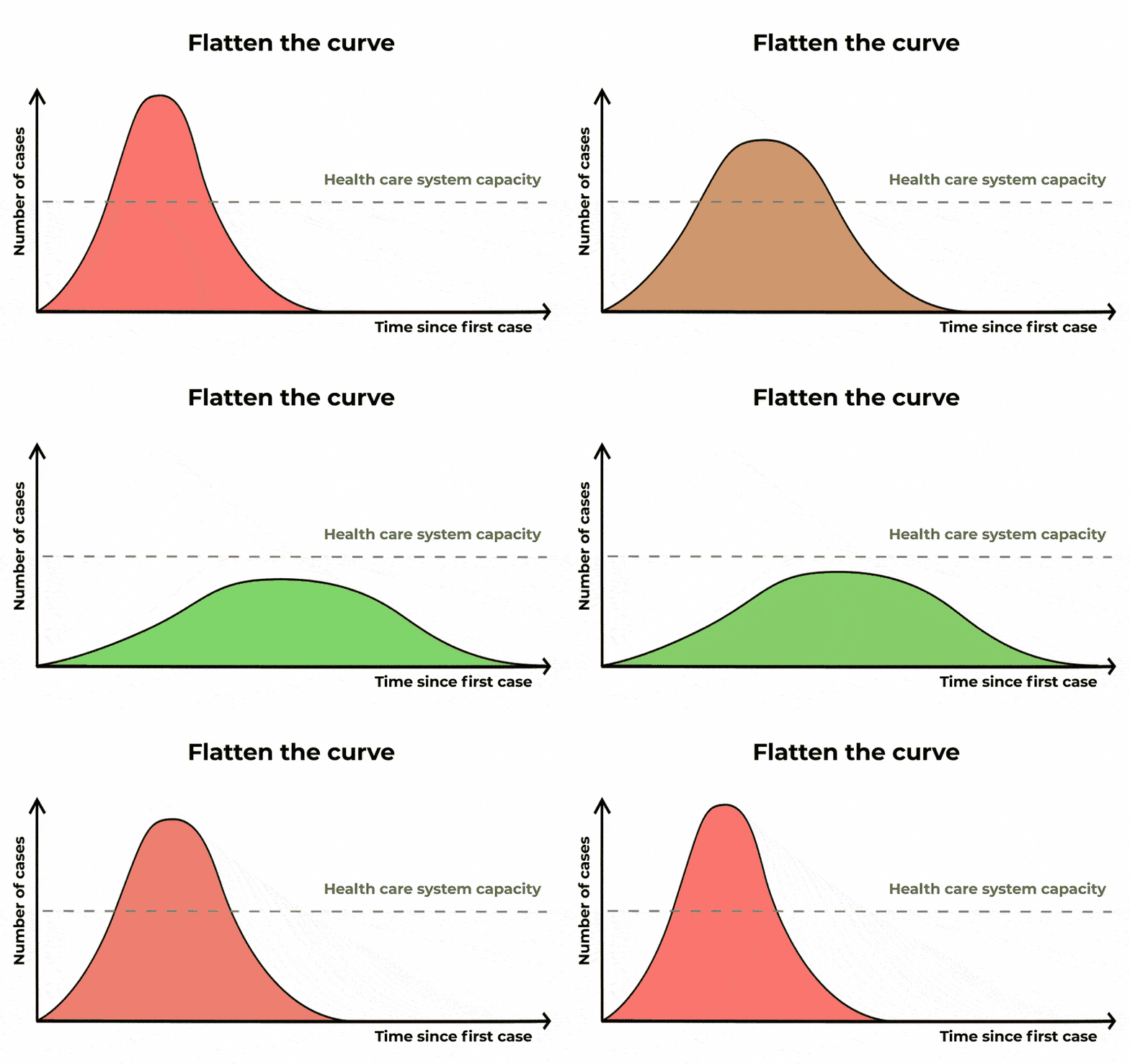
“Flattening the curve” is another way of saying “slowing the spread.” The epidemic is lengthened, but we reduce the number of severe cases, causing less burden on public health systems. The Conversation/CC BY ND
But these posts miss COVID-19s infectiousness.
They also miss two other points.
This is the number of extra people one infected person is estimated to infect.
Flus R0is about 1.3.
Although COVID-19 estimates vary, its R0 sits around amedian of 2.8.
Its not only that COVID-19 is so deadly, but its also deadlyandhighly infectious.
Exponential growth and misleading graphs
A simple graph might plot the number of new COVID cases over time.
The steeper the upwards slope on the graph, the more we should be worried.
For COVID-19, statisticians look to trackexponential growthin cases.
Put simply, unrestrained COVID cases can lead to a continuously growing number of more cases.
This gives us a graph that tracks slowly at the start, but then sharply curves upwards with time.
This is the curve we want to flatten, as shown below.
An Israeli professorswidely-sharedanalysis claimed COVID-19s exponential growth fades after eight weeks.
Well, he was clearly wrong.
This led him to plot only the erratic growth of the outbreaks early phase.
Better visualizations truncate those erratic first cases, for instance by starting from the 100th case.
Not all infections are cases
Then theres the confusion about COVID-19 infections versus cases.
But there are many more infections than cases.
Infections cause cases, testing discovers cases.
But heand othersstill got it totally wrong.
More testing does notresultin more cases, it allows for amore accurate estimateof the true number of cases.
And the variation intime to recoveryis even greater.
Some people get really ill and take a long time to recover, some show no symptoms.
The rapid case-doubling time and protracted recovery time also create a large discrepancy between counts ofactive and recovered cases.
Well only know the true numbers in retrospect.
But few realize howmammoth, chaotic, andcomplexthe task is of tracking statistics on a disease like this.
Countries and even states may count cases and deaths differently.
It also takes time to gather the data, meaning retrospective adjustments are made.
Well only know the true figures for this pandemic in retrospect.
