Another day, another problematic AI study.
And no human can tell if any given human is lying.
Nobody can tell when anybody is lying all of the time.
It’s free, every week, in your inbox.
Thats a really weird statement.
What exactly is accuracy?

Base luck gives any system capable of choice a 50/50 chance.
And,traditionally, thats about how well humans perform at guessing lies.
Interestingly, they perform much better at guessing truths.
The Tel Aviv University teams paper even mentions that polygraphs arent admissible in courts because theyre unreliable.
But lets take a deeper look at the Tel Aviv teamsstudyanyway.
The team started with 48 participants, 35 of which were identified as female.
There was also compensation involved.
Thats a red flag.
Not because its unethical to pay for study data (it isnt).
But because its adding unnecessary parameters so you can intentionally or ignorantly muddy up the study.
Especially ones that are so half-baked they couldnt possibly be codified without solid background data.
How much impact does a financial incentive have on the efficacy of a truth-telling study?
That sounds like something that needs its ownlarge-scalestudy to determine.
Lets just move on to the methodology
The researchers paired off participants into liars and receivers.
Their partners job was to guess if they were being lied to.
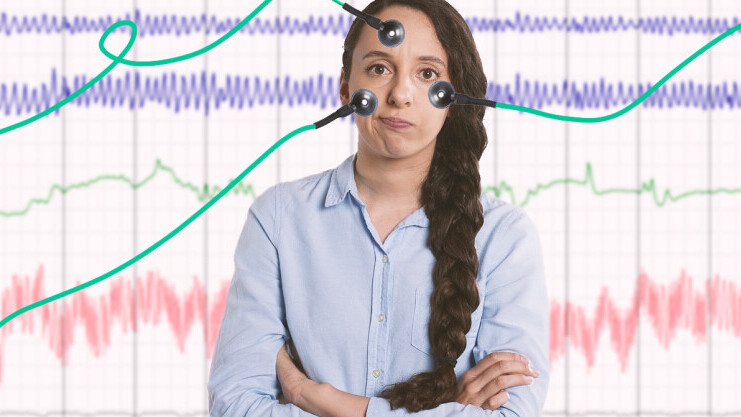
The researchers operated under an initial assumption that twitches in our facial muscles are a window to the ground-truth.
This assumption is purely theoretical and, frankly, ridiculous.
Scars and loss of muscle strength exist.
Yet, the researchers expect us to believe theyve invented a one-size-fits-all algorithm for understanding humans.
And they accomplished this by measuring muscle twitches in the faces of just 40 humans?
Computer vision already exists.
Either the data from the electrodes is necessary or it isnt.
Whats worse, they apparently intend todevelop this into a snake oil solution for governments and big businesses.
Once the technology has been perfected, we expect it to have numerous, highly diverse applications.
Police interrogations?
Exactly what percentage of those 40 study participants were Black, Latino, disabled, autistic, or queer?
Theres no real-world scenario analogous to this experiment.
And that 73% accuracy is as meaningless as a Tarot card spread or a Magic 8-Balls output.
The world needs more research like this, dont get me wrong.
Its important to test the boundaries of technology.
But the claims made by the researchers are entirely outlandish and clearly aimed at an eventual product launch.
