An Italian company has unveiled a novel method of measuringAIprogress: analyzing improvements in machine translation.
The Rome-basedbusinesssets this milestone at themoment when AI provides a perfect translation.
Translateds analysis suggests this will happen before the end of the 2020s.

It’s free, every week, in your inbox.
The reality is that in some specific domains and in a few languages this has already happened.
For some rare languages and domains it may never come.

Translateds estimates are basedon datataken fromMatecat, acomputer-assisted translation (CAT) tool.
The platform began life in 2011 as an EU-funded research project.
Three years later, the system was released asopen-source software, which professionals use toimprove their translations.
Translated offers Matecat as a freemium product.
In return, users provide the company with data thats used to improve its models.
To chart the path to singularity, Translated tracked the time users spentchecking and correcting 2 billion MT suggestions.
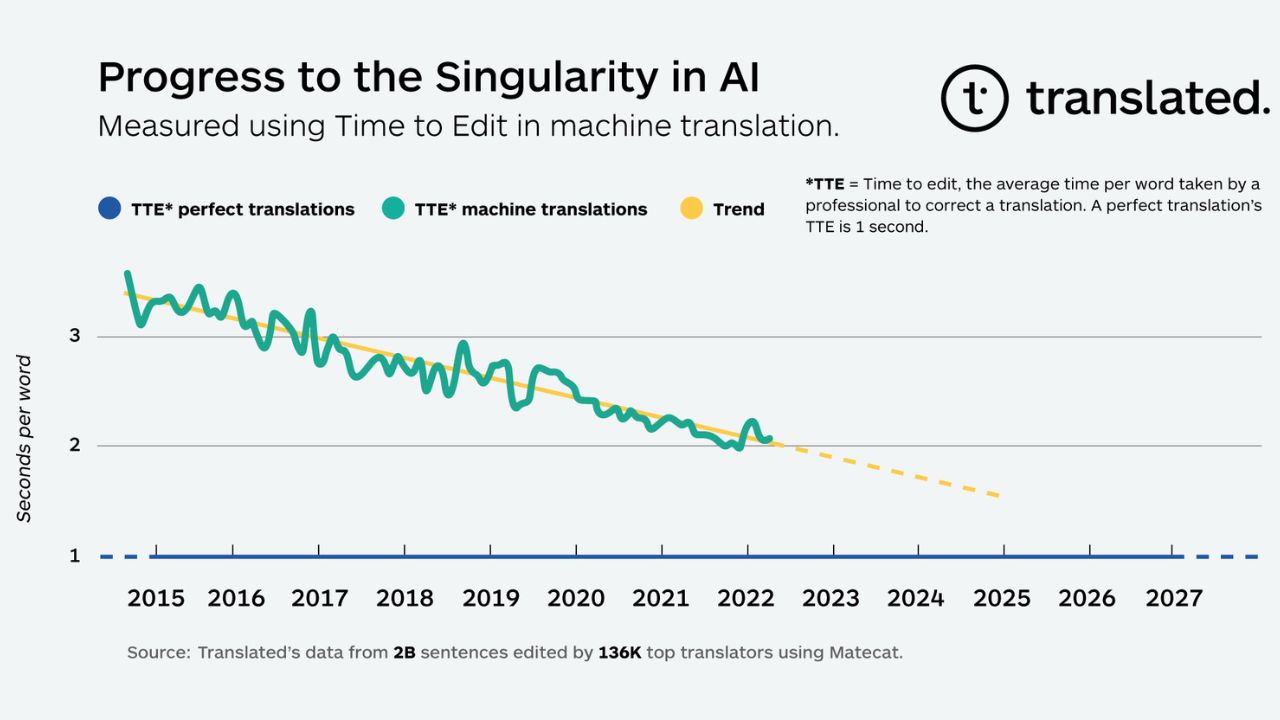
Around 136,000 professionals worldwide had made these edits across Matecats 12 years of operation.
The translations spanneddiverse domains, from literature to technical subjects.
They also included fields in which MT is still struggling, such as speech transcription.
Singularity is really close.
The data suggeststhat AI is rapidly improving.
Today, that numbers down to 2 seconds per word.
At the current rate, the time will hit 1 second in around five years.
At that point, MT would provide the epochal perfect translation.
In practical terms, it will then be more convenient to edit a machines translations than a top professionals.
Advances in MT require increasing computing power, linguistic data, and algorithmic efficiency.
Consequently, theresearchers had presumed progress would slow as singularity approached.
To their surprise, the rate of development was highly linear.
Translated forecasts atleast a tenfold increase in requests for professional translations.
This generates business, and business generates higher-quality content that requires professionals.
Trombetti also expects new roles to emerge for elite translators.
MT is a good predictor of whats next in AI.
MT is simply a good predictor of what is coming next in AI, says Trombetti.
If what comes next is singularity, the Italian entrepreneur anticipates a new era for global communication.
He envisions universal translators, all content becoming globally available, and everyone able to speak their native language.
His definition of singularity may be questionable, but its appeal is undeniable.
Story byThomas Macaulay
Thomas is the managing editor of TNW.
He leads our coverage of European tech and oversees our talented team of writers.
Away from work, he e(show all)Thomas is the managing editor of TNW.
He leads our coverage of European tech and oversees our talented team of writers.
Away from work, he enjoys playing chess (badly) and the guitar (even worse).
