The technique has a potent claim on our imaginations.
These images are usually produced when other identification methods have failed.
Its usually a last resort with very high stakes.

Facial reconstruction becomes most culturally visible when it is applied toarchaeological research.
Depicting past people enables viewers to imagine them as individuals rather than specimens.
This research is facilitated by advances in imaging technologies, and benefits from interdisciplinary input.

It’s free, every week, in your inbox.
The project involved creating facial depictions based onhuman remains unethically acquiredby theUniversity of Cape Townin the 1920s.
The project has become a platform to ventilate the unfinished business of human remains discovered fromSouth Africas unpleasant past.
It has also set a precedent for repatriation and restitution initiatives.
The project has also demonstrated how science, art and technology converge in contemporary facial reconstruction and depiction.
The surface details of a face, known here as texture, are a matter of interpretation.

The final depiction should employ visual strategies known to optimize recognition, but also infer ambiguity where necessary.
This was necessary for three individuals in this group.
Where bony fragments were missing or damaged, reassembly was a necessary first step.
The more bone is absent, the more qualified the final result.
Face Lab employs a 3D modeling program with a haptic (touch-sensitive) interface.
Extensive visual research guided our final presentation choices for the Sutherland faces.
Clothing was suggested based on contemporaneous archival photographs taken in the same broad geographical area.
Older adults would have likely had more heavily wrinkled skin than contemporary people of the same chronological age.
They are historical interpretations produced with forensic fealty.
The level of realism was clearly unnerving, but ultimately compelling.
The faces were ciphers for a process of recognition that was about being seen and heard.
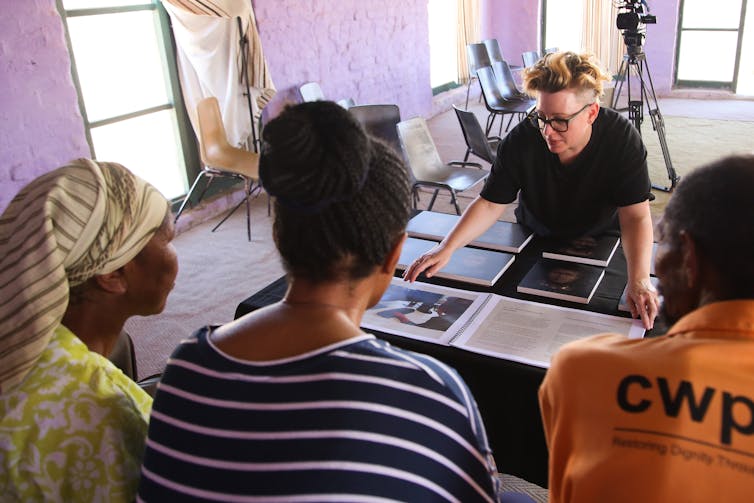
Showing the families the facial reconstructions of their ancestors previously buried on Kruisrivier farm in Sutherland.
Local heritage practices in South Africa have not taken advantage of what these techniques can deliver.
The biographies this process was able to reconstruct, embodied in these eight faces, are highly specific.
