Black holes helped to explain new astronomical discoveries, becoming essential ingredients of astrophysics.
Science regardedblack holes as abstractions until the 1960s.
The recent experimental discovery of gravitational waves has changed our understanding of what black holes are.
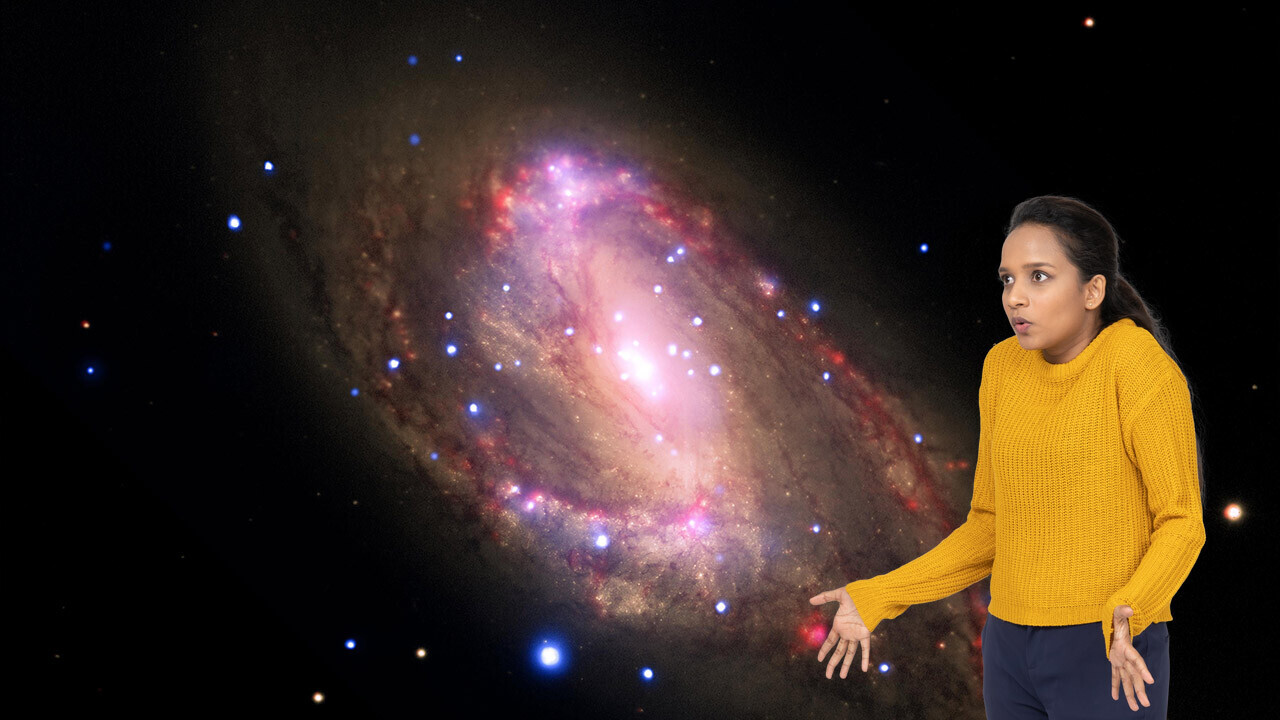
In 2019, theEvent Horizon Telescopereleased an image of the supermassive black hole in the nearby galaxy M87.
What is a black hole?
40% off TNW Conference!
Whatever falls into the event horizon is lost forever.
This means that the black hole must be monitored forever to know that nothing exits.
In practice, this is impossible.

a black hole is formed.
New black holes
Perfectly isolated or unchanging black holes do not exist.
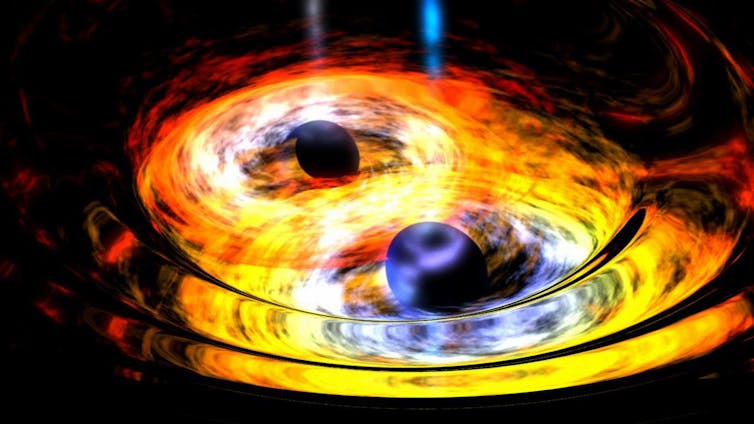
Two black holes surrounded by yellow and orange flames spiraling into each other.
Image via NASA
The2016 LIGO/Virgo gravitational wavesoriginated in the spectacular merger of two black holes.
Instead, simulations use theapparent horizon, characterized by the property that nothing can escape from itnow.
Apparent horizons have played a crucial role in the newly borngravitational wave astronomy, but are surprisingly little known.
Black holes change because they live in anexpanding universe.
Theoretical physicist Stephen Hawking predicted that all black holesradiate energy due to quantum mechanics, which makes them shrink.
Although negligible for practical purposes, this radiation is unavoidable in principle.
New understandings
Our understanding of black holes is based on the mathematical definition of horizon.
But how light rays behave depends on the observer describing them using mathematical simulations.
So, the apparent horizon itself depends on the observer.
Admittedly, these mathematical observers are very artificial.
Scientists have finally detected gravitational waves from black holes but had to change the way they understand them.
The essence of black hole theory is now different.
