Europes housing crisis is deepening.
High building costs, tight regulations, and labour shortages have choked the supply of affordable homes.
Endless solutions have been proposed.
But the shortage of affordable housing has only grown.
Dutch startupMonumentalhas pitched another fix: automation.
The company is developing a suite of autonomous, electric robots that work on construction sites around the clock.

Its obvious that we need some forms of automation and robotics to solve these problems, he tells TNW.
Theres almost no other way around it.
AtTNW Conferenceon June 19-20 in Amsterdam, al Khafaji will share his tips on building a thriving robotics business.
Ahead of his talk, he outlined his vision of the future of construction.
When Silk was acquired by US analytics giant Palantirin 2016, he began pondering his next venture.
His plan was to focus on a major global challenge.
I wanted to solve a serious problem in society, he says.
And I became obsessed with construction and infrastructure.
Al Khafaji was stunned to see so little technological progress in the industry.
The built world in which we live, work, and play had become severely restricted as a result.
His focus turned to a central problem: a productivity collapse in construction.
Labour shortages, strict regulations, and high costs, he feared, were worsening the housing crisis.
New developments had become eye-wateringly expensive and painfully slow to construct.
They also often result in unpopular buildings.
The past offers unflattering comparisons.
The Empire State Building, for instance, was completed in 1931 after just 410 days.
The problem extends beyond landmark buildings.
Construction of standard homes has also lost pace.
Longer projects also bring higher costs, with labour often forming the bulk.
Its very, very labour-intensive because weve barely automated anything there, al Khafaji says.
Monumental is his attempt to overhaul the status quo.
Their big idea was automating on-site construction with robotics and software.
The first finished system off the production line focused on one crucial construction craft: bricklaying.
It was a logical starting point.
Bricklaying is a skilled but physically demanding and sometimes dangerous job with a rapidly dwindling workforce.
As a result, construction projects suffer from delays and increased costs.
With the profession struggling to attract young talent, the shortage of workers is only set to grow.
Monumentals systems aim to fill the gap and, ultimately, strengthen the supply of affordable housing.
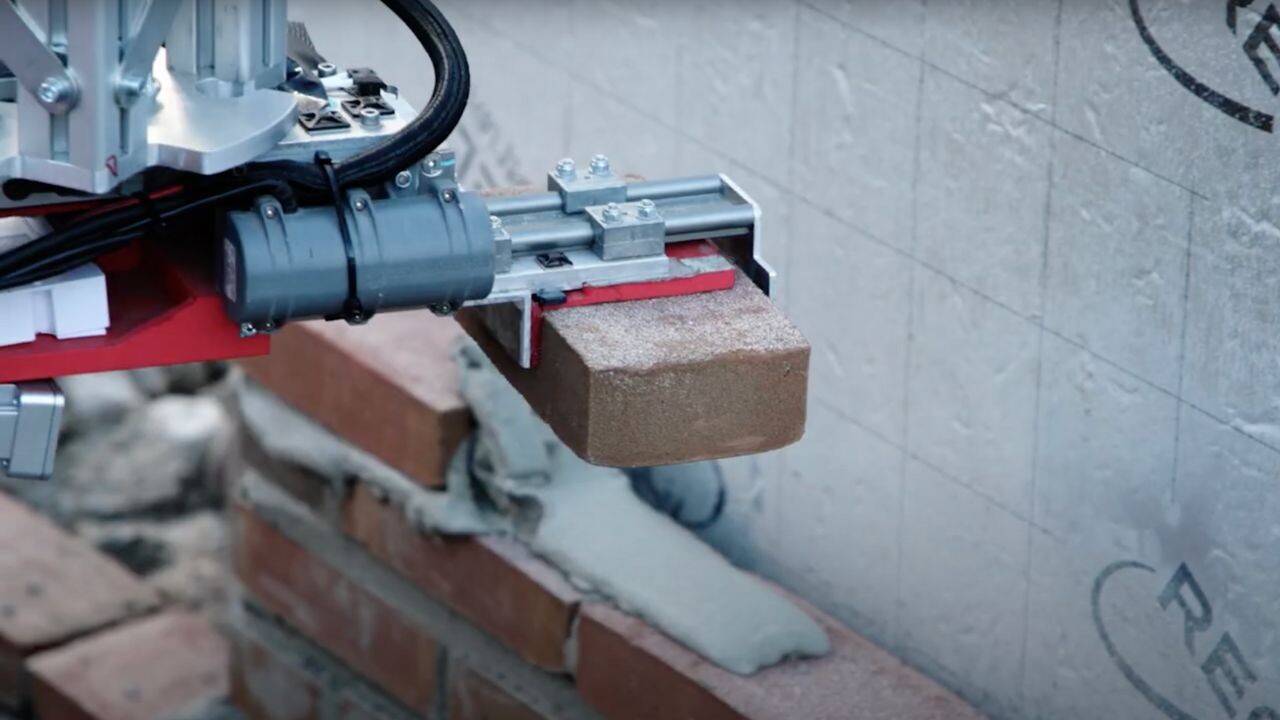
The startups electric bricklayerrobotswork autonomously alongside humans.
Using sensors, computer vision, and small cranes, the machines precisely lay bricks and mortar in walls.
The robot builders
Al Khafaji compares the robots to distributed computers.
Composed of multiple, interconnected modular components, they function like online grid devices.
To prepare the machines for construction jobs, the startupssoftwaremodels both the site and the robots themselves.
A machine vision stack then allows them to localise in the building zone.
While they work, AI coordinates their tasks.
We really think of it as an operating system for construction sites, al Khafaji says.
Were trying to make construction more software-defined.
In 2023, the robots completed their first large-scale, 15-metre wall.
Investors have been impressed by the progress.
Last year, Monumentalraised $25mnin seed funding to bring the concept closer to reality.
But the company still has to win over the construction industry.
Bricklayers, for example, continue working in much the same way.
Shipyard workers, by contrast, have had their jobs transformed if not replaced by containerisation and automated pickers.
Al Khafaji was shocked by constructions lack of innovation.
Construction basically works the same way as a century ago.
Its a curious inertia given the size of the industry.
Construction employs over 100 million people and accounts for about 13% of global GDP.
Yet the sector still cant come close to matching demand.
Since then, the country has consistently fallen short of the target.
Automation and digital tools could bring enormous benefits on building projects.
But construction firms have historically been reluctant to adopt them.
The industry is typically cautious of new technologies for fundamentally logical reasons.
Businesses often operate on boom-and-bust cycles, prioritising financial reserves over long-term investments in new, unproven ideas.
No one wants to take a bet, al Khafaji says.
Monumental hopes to ease the industrys concerns.
Quotes are offered in common market terms, such as per square metre or brick.
Standard materials are used, supply chains are conventional, and clients arent asked to do CapEx investments.
At any point, they can also swap the technology out for human masons.
Were not selling them robots, al Khafaji says.
Were not selling them software licenses…
Were selling them a wall.
But bricks on walls are just the start of Monumentals plans.
The company plans to apply robotics to numerous building tasks.
A brick is just a building block, al Khafaji says.
You could imagine the brick being different things concrete blocks, window frames, door frames, roofing elements.
All these things, you grab them, hold them, and put them in a different place.
Monumental estimates that these functions account for a third of the tasks on a construction site.
As the technology evolves, autonomous machines could take on even more building jobs.
Al Khafaji has grand visions for the future.
Thats an almost science fiction version of this, where everything is automated, he says.
Story byThomas Macaulay
Thomas is the managing editor of TNW.
He leads our coverage of European tech and oversees our talented team of writers.
Away from work, he e(show all)Thomas is the managing editor of TNW.
He leads our coverage of European tech and oversees our talented team of writers.
Away from work, he enjoys playing chess (badly) and the guitar (even worse).
