Why do we exist?
Butour new experimentat CERNs Large Hadron Collider has taken us a step closer to figuring it out.
To understand why, lets go back in time some 13.8 billion years to the Big Bang.

This event produced equal amounts of the matter you are made of and something calledantimatter.
When a particle and its antiparticle meet, they annihilate each other disappearing in a burst of light.
Had there ever been an equal amount of antimatter, everything in the universe would have been annihilated.
Our researchhas unveileda new source of this asymmetry between matter and antimatter.
The positrons occur in natural radioactive processes, such as in the decay of Potassium-40.
This means your average banana (which contains Potassium) emits a positron every 75 minutes.

These then annihilate with matter electrons to produce light.
Medical applications like PET scanners produce antimatter in the same process.
40% off TNW Conference!
There aresix kinds of quarks: up, down, strange, charm, bottom and top.
Similarly, there aresix leptons: the electron, muon, tau and the three neutrinos.
There are also antimatter copies of these twelve particles that differ only in their charge.
Antimatter particles should in principle be perfect mirror images of their normal companions.
But experiments show this isnt always the case.
Take for instance particles known asmesons, which are made of one quark and one anti-quark.
Neutral mesons have a fascinating feature: they can spontaneously turn into their anti-meson and vice versa.
In this process, the quark turns into an anti-quark or the anti-quark turns into a quark.
Both discoveries led to Nobel Prizes.
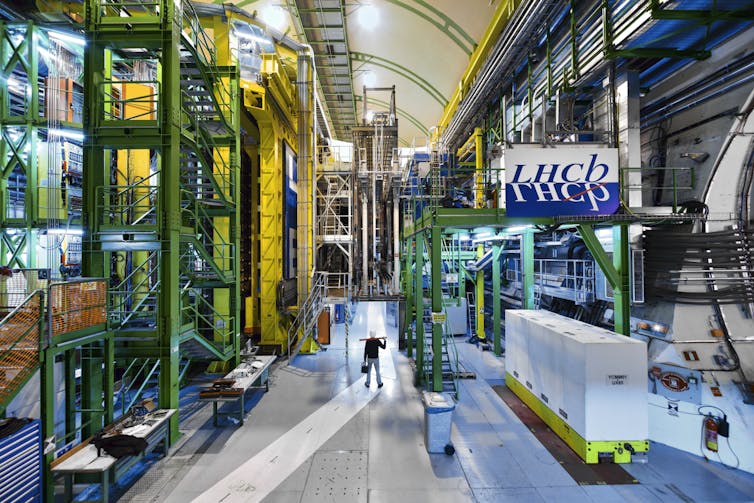
Maximilien Brice et al./CERN
Both the strange and bottom quark carry a negative electric charge.
Theory suggests that if it does, then the effect should be tiny and difficult to detect.
The result indicates that the chance of this being a statistical fluctuation is about 50 in a billion.
And thats important as the few known cases of asymmetry cant explain why the universe contains so much matter.
Over the coming decade, the upgraded LHCb experiment will boost the sensitivity for these kinds of measurements.
This will be complemented by theJapan-based Belle II experiment, which is just starting to operate.
These are exciting prospects for research into matter-antimatter asymmetry.
Antimatter is also at the heart of a number of other experiments.
Whole anti-atoms are being produced atCERNs Antiproton Decelerator, which feeds a number of experiments conducting high precision measurements.
TheAMS-2 experimentaboard the International Space Station is on the lookout for antimatter of cosmic origin.
This article is republished fromThe ConversationbyMarco Gersabeck, Lecturer in Physics,University of Manchesterunder a Creative Commons license.
TNW Conference 2019 is coming!
