What does the term crocodylian bring to mind?
A big reptile with a chomping jaw?
There are some smaller species, but these top predators are usually big, at least 2 meters long.
But exactly which environmental factors might have influenced the body sizes of crocs throughout their evolution?
And does the body size of crocs suggest something about past species extinction?
40% off TNW Conference!
Body size can reveal a lot about the biology of extinct animals.
Our study was the first to apply some modern computational methods to understand body size evolution in crocs.
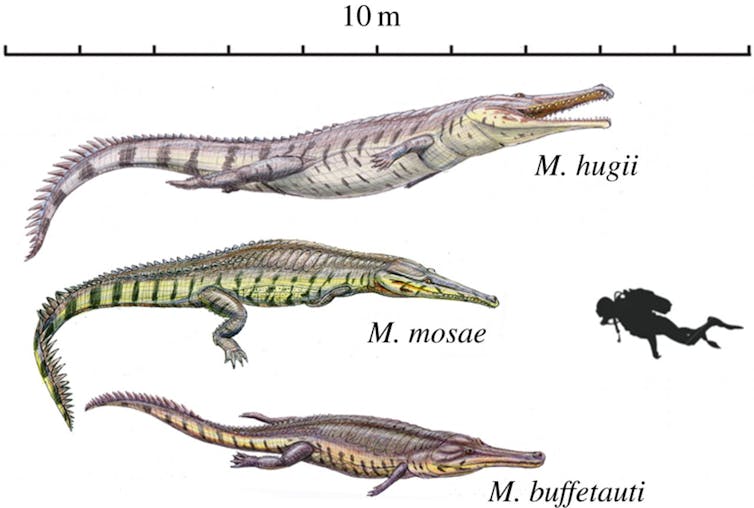
Some ancient crocs were giants.
See the human diver in this illustration for scale.
Theres much more ecological diversity on display in the fossil record than what you see in modern crocodylians.
The oldest crocs, alive during theTriassic Period, were small, rarely more than 1 meter long.
This pattern is known asCopes rule.
Scientists have spotted this tendency inmammals,dinosaursand,pterosaurs.
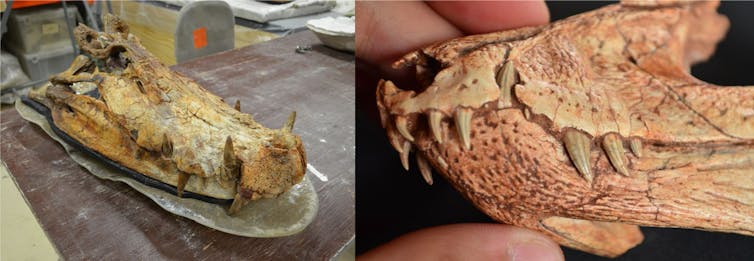
In our case, we used skull length as a proxy for total body size.
The remaining information came from other researchers photographs or figures in the scientific literature.
Left, a big Kaprosuchus skull in the paleontological collection at the University of Chicago.
Right, a tiny Gondwanasuchus skull at the Paleontology Research Center, Peiropolis, Brazil.
One important clue appeared when we analyzed how body size changes across different lifestyles.
We divided crocs into three ecological categories: land-based, semi-aquatic and fully aquatic.
We found that terrestrial crocs are significantly smaller than semi-aquatic and marine ones.
Other researchers have documented similar findings for mammals, withmarine species larger than their terrestrial relatives.
One explanation for this might be the adaptations that are necessary for life in the aquatic realm.
For example, having a large body might helpmaintain an optimal temperature in the water.
We also investigated whether environmental factors temperature and geographical distribution had an influence on croc body size.
But when we subdivided the species into smaller subgroups, we found some interesting results.
One of these subgroups is Crocodylia, which includes modern crocodylians and only their closest extinct relatives.
They lived mostly during theCenozoic thats our current era which began after theextinction of nonavian dinosaurs66 million years ago.
For Crocodylia, we found that larger sizes tend to be found with lower temperatures.
This might seem counterintuitive, becausecrocs and other reptiles like warmer places.
This could have increased competition in their habitats and perhaps larger crocs were more successful.
In the end, lower temperatures probably led smaller crocs to extinction.
A more nuanced picture of evolving size
There are two take-home messages from this discovery.
First, scale matters.
When we analyzed all crocs together, we did not find significant correlations.
The second is that climate change can shape the evolution of species.
This is pretty obvious, andprevious studies have shown it for other animals.
Crocs became more restricted to the tropics and this possibly led to the extinction of smaller species.
