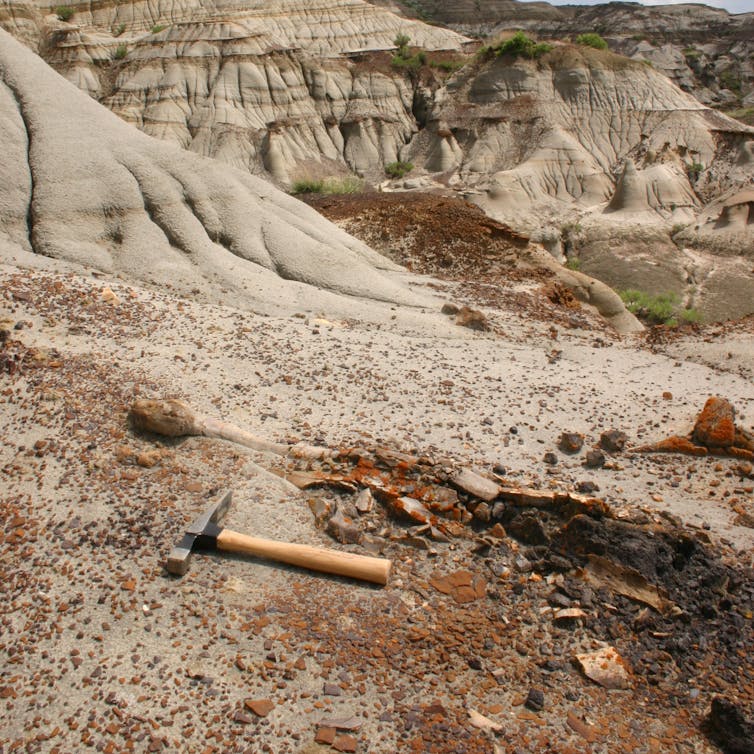
One of the tricks you learnhunting dinosaursin Canada is to look for orange.
Dinosaur bones are dull browns, tans, and greys.
Walk over and you may well find a dinosaur bone weathering out.
The orange is lichen, growing on the bone.
Life exists almost everywhere on Earth.
Bacteria thrive in hydrothermal vents, fungi growinside Chernobyl, nematode worms crawlunder Antarcticice fields.
Why wouldnt life also inhabit buried fossils?
If it does, that creates problems for identifying the original biological material of fossils.
Most of theoriginal bone mineral calcium phosphate survives.

Its the same stuff that was inside a living, breathing dinosaur millions of years ago.
It’s free, every week, in your inbox.
Remarkably, organic molecules can sometimes persist.
Even more remarkable claims have been announced, includingDNA,proteinsand evencells and blood vesselsfrom dinosaur bone.
The idea of recovering dinosaur tissues and using dinosaur DNA and proteins to reconstruct evolution is tantalizing.
But its unclear how, or if, they can survive tens of millions of years.
Half the DNA in a fossil disappears roughly every500 yearsand DNA should become unreadable in 1.5m years.
Proteins are more resilient.
Meanwhile, living things bacteria,protists, fungi, plant roots and nematodes thrive underground.
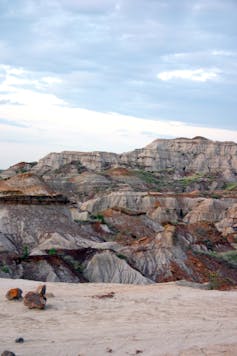
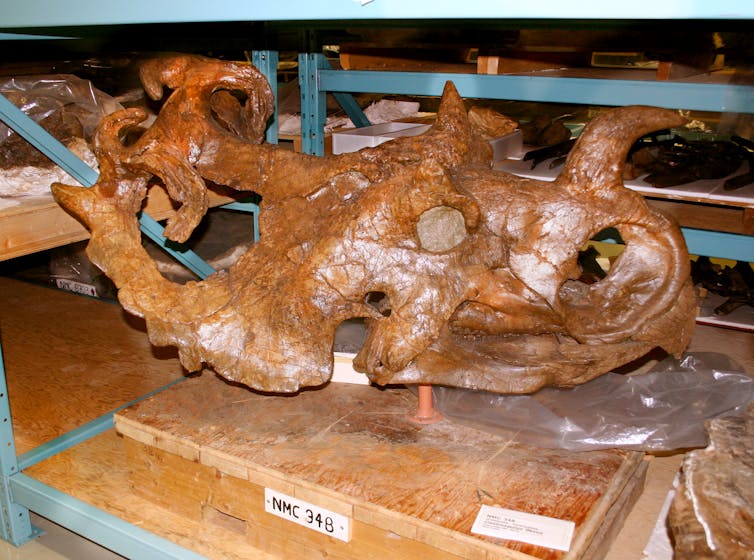
We excavated aCentrosaurusbonebed in Dinosaur Provincial Park, Alberta.
But they were still full of life, coming from inside the bone.
Amino acids extracted from the fossils showed theunmistakable signature of life.

Amino acids exist in left- and right-handed configurations.
We also studied the carbon in the bones.
Living things take carbon from atmospheric CO2, which contains radioactive carbon-14.
Carbon-14 undergoes radioactive decay, with half its atoms disappearing roughly every 6,000 years.
No detectable carbon-14 should survive from 76m years ago, but the bones were full of it.
Either these dinosaurs died a few thousand years ago, or they were contaminated by living things.
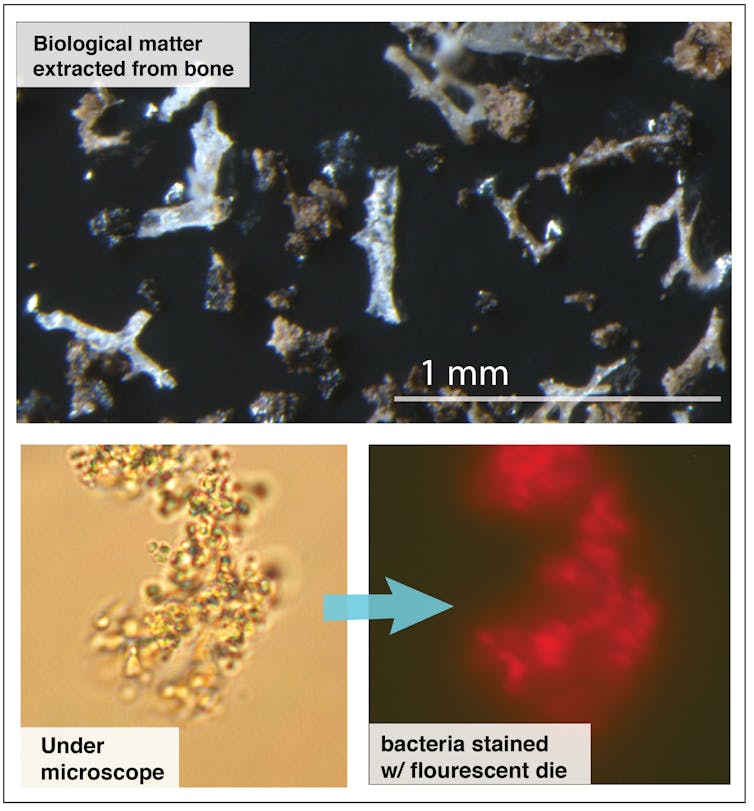
What we found was astonishing: a thriving community of bacteria.
The bones had 50 times the bacterial DNA as the surrounding mudstones.
They werent empty tombs, but teeming with a unique microbial community, a microbiome.
Bone also contains phosphorus needed to make DNA and cell membranes.
The abundant DNA suggests these organics are made by bacteria, not dinosaurs.
And although we didnt find dinosaur proteins, we found something equally remarkable, life inside that dinosaur.
When ourCentrosaurusdied, its body fed other living things tyrannosaurs, flies, beetles, then bacteria and fungi.
But the process continued long after death.
