Our prototype stores information in patterns using DNA strands spaced about 10 nanometers apart.
We described the research in a paper published in the journal Nature Communications on April 22, 2021.
Previous methods for retrieving data in DNA require the DNA to be sequenced.
Sequencing is the process ofreading the genetic code of strands of DNA.
Though it is a powerful tool in medicine and biology, it wasnt designed with DNA memory in mind.
Our approach uses a microscope to read the data optically.
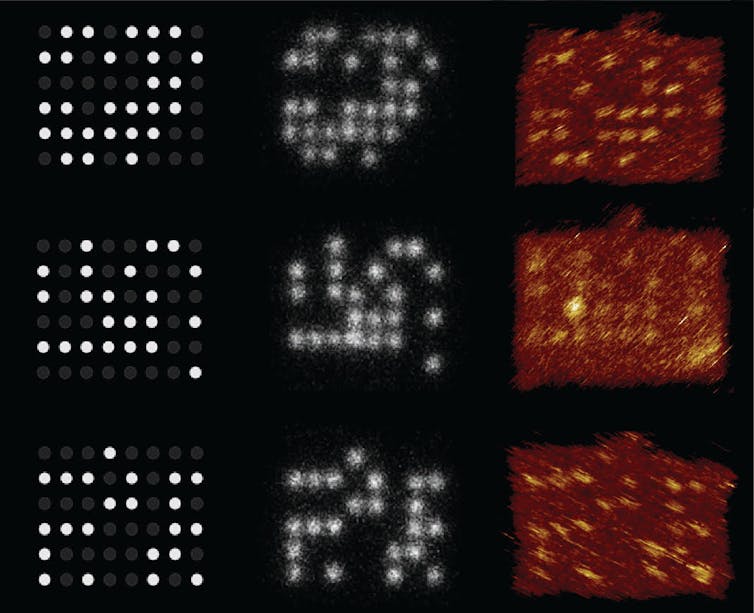
This provides a way to read the encoded data without sequencing the DNA.
Each 6 x 8 pegboard is roughly 70 x 90 nanometers.
Because the fluorescent strands are short, they rapidly bind and unbind.

We use the fluorescent patterns of each pegboard as a code to store chunks of data.
40% off TNW Conference!
DNA data storage is promising for archival storage storing large amounts of information for long periods of time.
DNA can store a lot of information in a small space.
What other research is being done
Researchers have beendeveloping methods of storing data in DNAfor several decades.
This information is recovered by reading the strings using sequencing technology.
