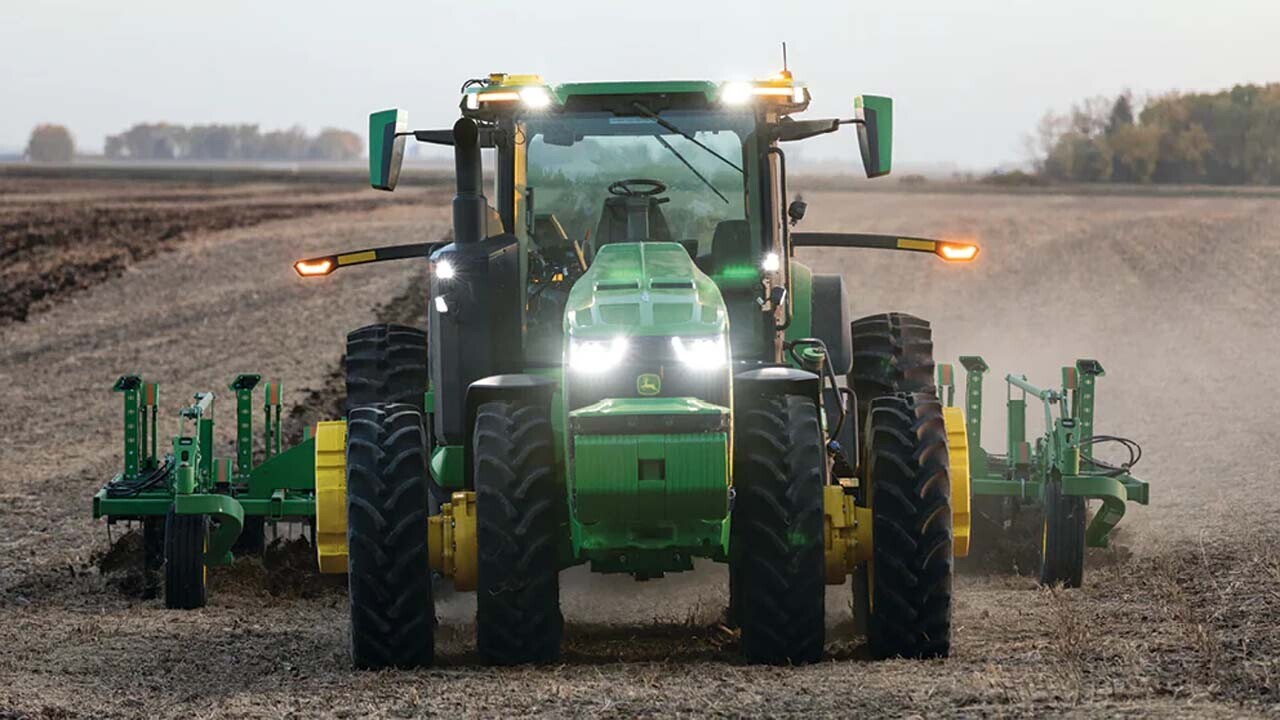
John Deere is announcing the acquisition of a state-of-the-art algorithm package fromartificial intelligencestartupLight.
Up front:No, you wont be seeing green tractors rolling themselves down city streets anytime soon.
But the timeline for fully autonomous farming is being massively accelerated.
It’s free, every week, in your inbox.
This is similar to the approach that Tesla takes for its Full Self-Driving (FSD) system.
Wevecriticized vision-only approachesin the past here at Neural, but this is different.

On a farm, the stakes are much different.
The current industry-standard solution for autonomy (usually) involves using a combination of LiDAR and computer vision.
But thats not necessarily the best way to go about things in the agricultural space.
A little deeper:LiDAR is costly and doesnt really allow for the close-up fidelity necessary for agricultural operations.
Deeres autonomous vehicles have to be more like robot workers than mere transportation vessels.
And, for that, they need to focus on sensing at speeds and resolutions that suit client needs.
As Pell told me:
The perfect sensor is a camera that gives you LiDAR-quality depth.
Unfortunately, cameras typically need to be motionless so that properly process light for depth.
Modern systems overcome this through the use of image-stabilization algorithms.
And thats just the tip of the iceberg.
Lights technology will allow Deere to compensate for all these problems using industry-standard cameras.
That means the company can keep hardware costs low by applying cutting-edge algorithms to gear it potentially already has.
Quick take:Deeres already made quite a splash in autonomy and automation.
But this acquisition gives us every reason to update that assessment its nowquicklybecoming the AI company to watch.
Everyone needs to eat.
Its hard to think of a better use-case for autonomy than optimizing humanitys ability to feed itself.
