This was successfully treated with medication by doctors on Earth, avoiding surgery.
Surgical emergencies are in fact one of the main challenges when it comes to human space travel.
Mars is a whopping 54.6 million kilometers (33.9 million miles) away from Earth, when closest.

In comparison, the International Space Agency (ISS) orbits just 400 kilometers above Earth.
This is tough on astronauts bodies and takes time getting used to.
It’s free, every week, in your inbox.

We already know that space travelchanges astronauts cells, blood pressure regulation and heart performance.
It also affects the bodys fluid distribution andweakens its bones and muscles.
Space travelers may also more easily develop infections.
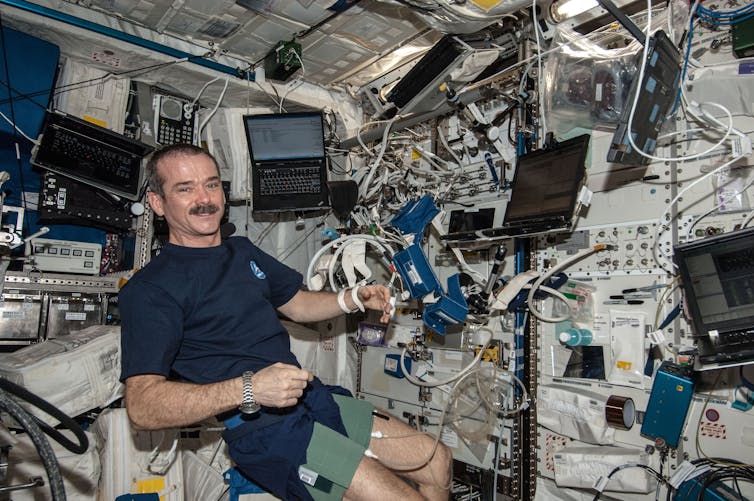
Astronaut Chris Hadfield using a cardio lab at the ISS.
NASA
But how likely is it that an astronaut will actually need surgery?
The main causes include injury, appendicitis, gallbladder inflammation or cancer.
A laroscopywas recently carriedout on fake abdomens during aparabolic zero gravity flight, with surgeons successfully stemming traumatic bleeding.
But they warned that it would be psychologically hard to carry out such a procedure on a crew mate.
Bodily fluids will also behave differently in space and on Mars.

The blood in our veins may stick to instruments because of surface tension.
Floating droplets may also form streams that could restrict the surgeons view, which is not ideal.
The circulating air of an enclosed cabin may also be an infection risk.
Surgical bubbles and blood-repelling surgical tools could be the solution.
Researchers have already developed and tested various surgical enclosures in microgravity environments.
This would be a dedicated module with filtered air supply and a computer to aid in diagnosis and treatment.
This is a luxury the crew may not have on a virgin voyage to Mars.
You cannot take much equipment on a rocket.
It has thereforebeen suggestedthat a 3D printer could use materials from Mars itself to develop surgical tools.
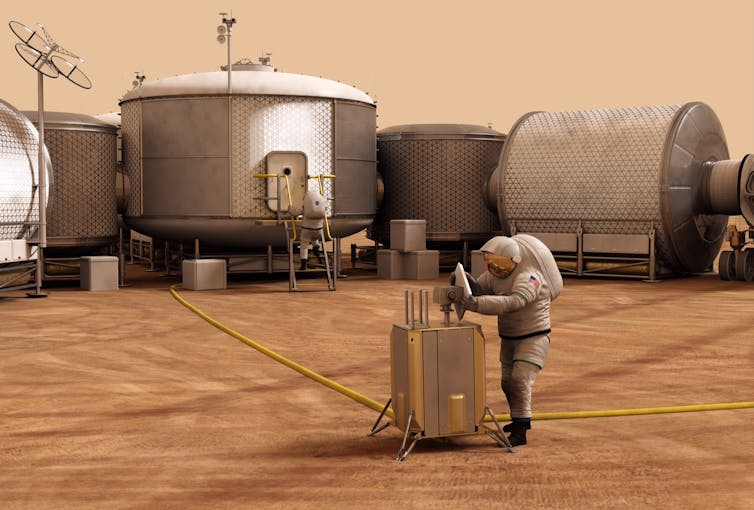
A Mars settlement would need a traumapod.
NASA
Robotic surgery is another option that has been used routinely on Earth, and tested for planetary excursions.
However, the lag in communications in space will make remote control a problem.
Ideally, surgical robots would need to be autonomous.
Ultimately, prevention is better than surgery.
So selecting healthy crew and developing the engineering solutions needed to protect them will be crucial.
