The rings were unlike anything seen before, and we had no idea what they were.
We dubbed them odd radio circles or ORCs.
They continue to puzzle us, but newdatafrom South AfricasMeerKATtelescope are helping us solve the mystery.
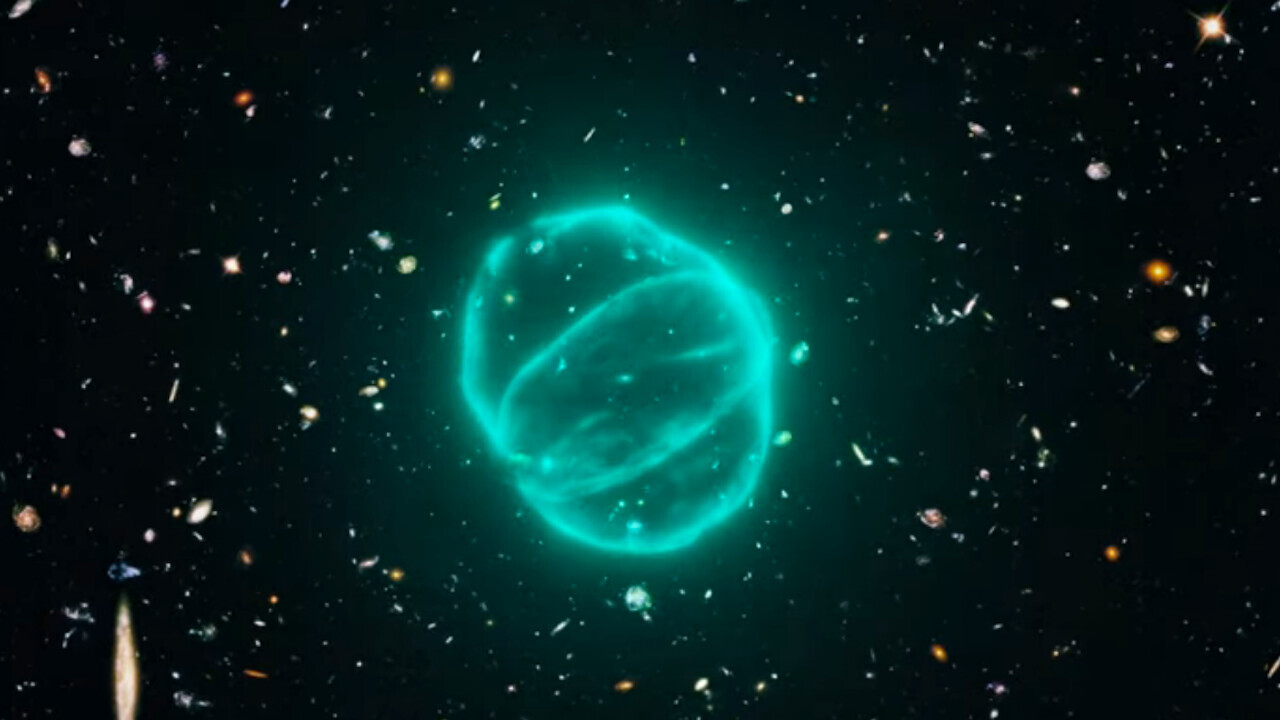
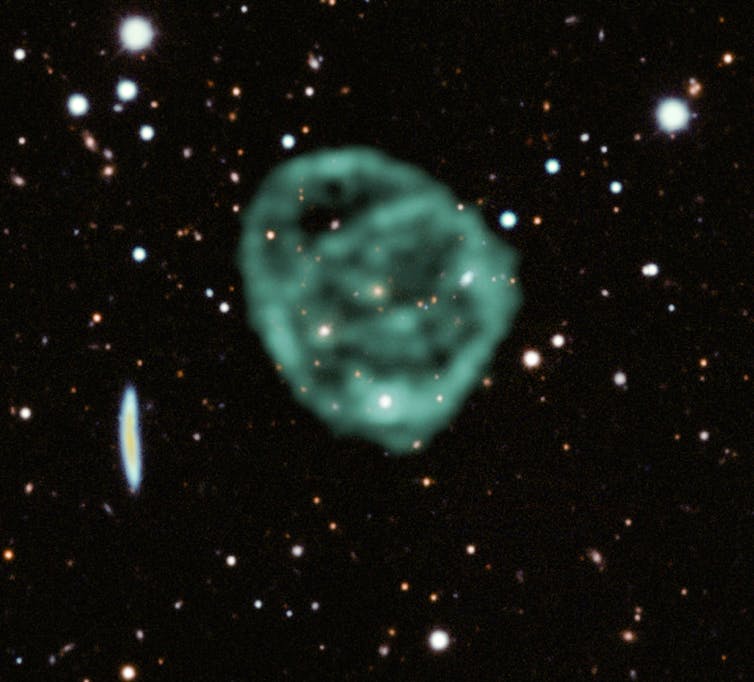
We can now see each ORC is centered on a galaxy too faint to be detected earlier.
Our paper showing these resultshas been peer-reviewed and accepted for publication by Monthly Notices of the Royal Astronomical Society.
It’s free, every week, in your inbox.

Created by Jayanne English using data from MeerKAT and the Dark Energy Survey.
We are now fairly certain this galaxy generated the ORC.
We see these central galaxies in other ORCs too, all at vast distances from Earth.
MeerKAT has also mapped thepolarisationof the radio waves, which tells us about the magnetic field in the ring.
Our polarisation image shows a magnetic field running along the edge of the sphere.
Lines around the edge of the ORC show the direction of the magnetic field.
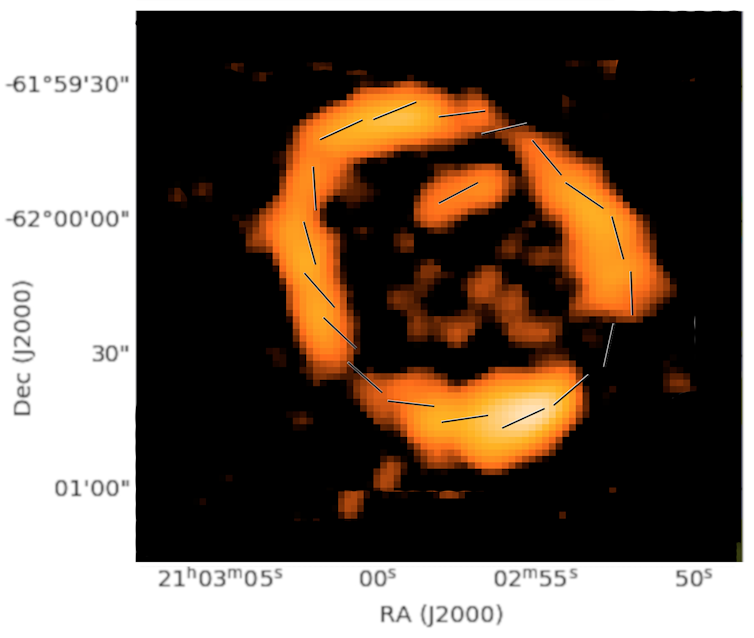
A circular magnetic field like this indicates it has been compressed by a shock wave from the central galaxy.
Created by Larry Rudnick from MeerKAT data.
We still dont know what these are.

Perhaps the filaments are trails of gas ripped off the galaxies by the passing shock wave?
Colliding black holes or the birth of millions of stars?
The big question, of course, is what caused the explosion.
We are exploring two possibilities.
One is that they were due to the merging of twosupermassive black holes.
Such a merger event releases an enormous amount of energy, enough to generate the ORC.
Such a starburst causes hot gas to blast out from the galaxy, causing a spherical shock wave.
ASKAP and MeerKAT were built to test the sites and technology for the SKA.
Their success in discovering and studying ORCs, therefore, bodes well for the SKA.
The SKA promises to surpass both.
