South Africa has thehighest emission intensity in the G20group of industrialized and developing countries.
This threatens its commitment to help slow global warming.
This disproportionate contribution is driven by the countryscoal-dependent national electricity utility, Eskom.
In generating power, its plants release512 billion kgof carbon dioxide into the atmosphere annually.
To reach its targets, South Africa must reduce emissions by 32% in the next 10 years alone.
But Eskom is also the engine of the economy andstruggles to meet currentdemand, with frequent rolling blackouts.
Internationally, electric vehicles have beenconsidereda way to reduce emissions.
Currently, onlyaround 1,000of the vehicles on South Africas roads are electric, withsubstantial growth expected.
They would alsoadd to the strainon the electricity grid.

Unfortunately, electric vehicles tend to be charged at home and at night when its dark.
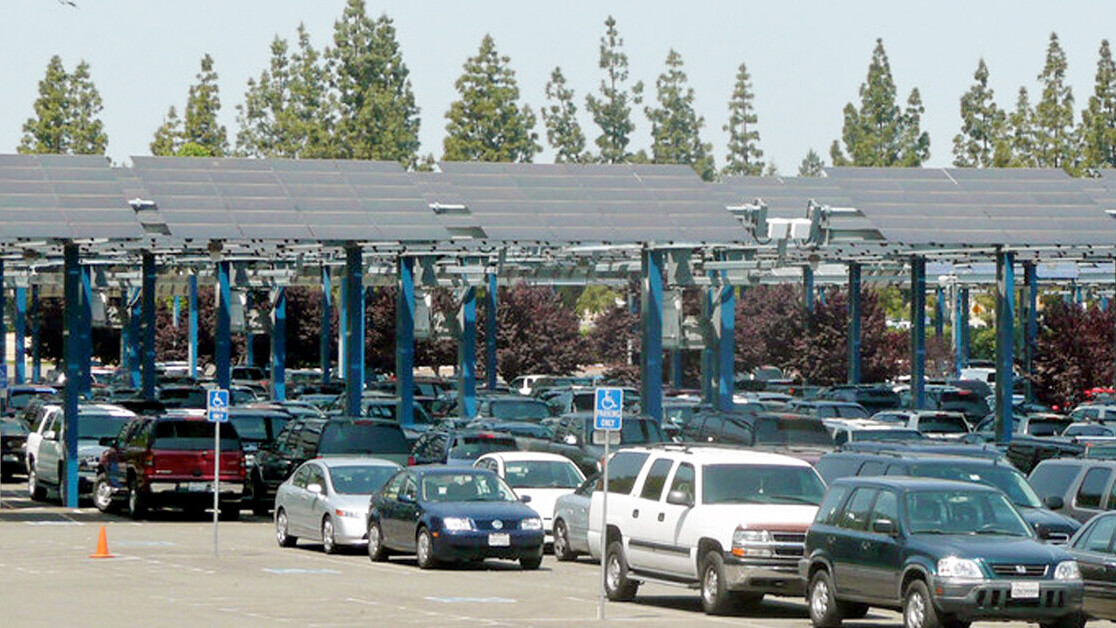
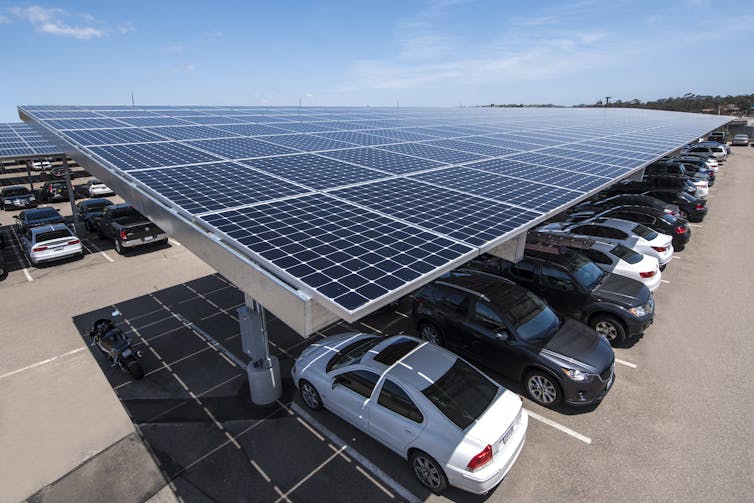
A solar photovoltaic carport.
Daytime charging from solar would consume energy directly and locally.

It would avoid adding a load to the electricity system by adding electric vehicles.
We ran simulations based on one, 1,000, and one million vehicles.
The work scenarios used solar photovoltaic carport charging, augmented as needed with the mostly coal-powered grid.
We found that the cost can be more than halved if vehicle owners charge their vehicles at work.
Charging vehicles at the workplace using solar photovoltaic augmented carports would reduce the carbon footprint.
This would be the case whether the charging took place only at work or at home too.
More electric vehicles could be supported by Eskom and employers could potentially generate income from solar energy.
Any excess solar energy can be fed back into the building.
The financial benefit to the employee is larger when employees charge only at work.
The scenario where electric vehicles are charged only at home would put Eskom under the most pressure.
Adding just 4 million electric vehicles would exceed the energy capacity of a fully operational grid.
Clearly, the carbon footprint would be higher in this scenario.
We excluded the environmental impact of production and shipment and later disposal.
Kevin Buresh, a Masters in engineering student at Stellenbosch University, also contributed to this article.Read theoriginal article.
SHIFT is brought to you by Polestar.Its time to accelerate theshiftto sustainablemobility.
That is why Polestar combines electric driving with cutting-edge design and thrilling performance.Find out how.
