The US Constitution requires that a population count be conducted at the beginning of every decade.
This census has always been charged with political significance, and continues to be.
Thats clear fromthe controversies in the run-up to the 2020 census.

More populous states get more seats.
It’s free, every week, in your inbox.
A minimalist interpretation of the census mission would require reporting only the overall population of each state.

But the census has never confined itself to this.
The first census, in 1790, also made nonconstitutionally mandated distinctions by age and sex.
It had become a mind-numbingly boring, error-prone, clerical exercise of a magnitude rarely seen.
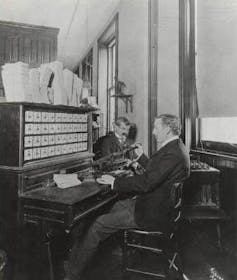
The Hollerith electric tabulating machine in use in 1902.
Thetechnological solutionsdevised by Hollerith involved a suite of mechanical and electrical devices.
The count proceeded so rapidly that thestate-by-state numbers needed for congressional apportionmentwere certified before the end of November 1890.
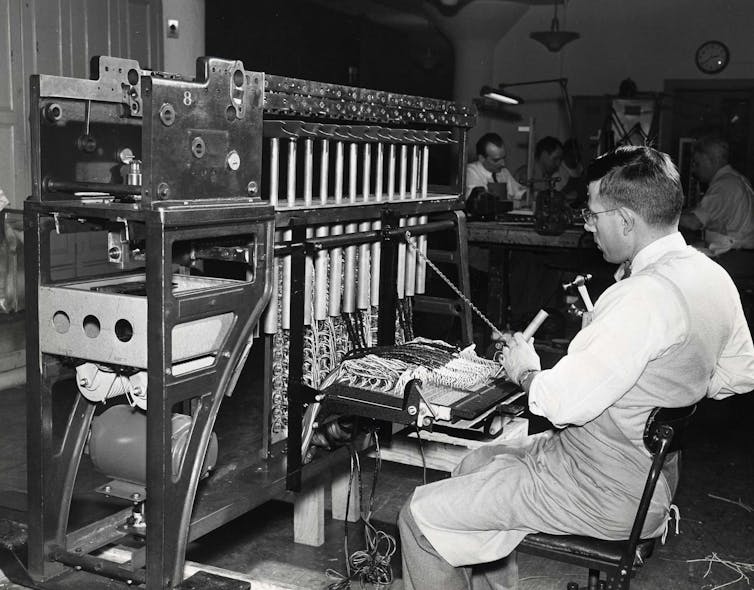
This mechanical punch card sorter was used for the 1950 census.
By the 1930s, many businesses were using cards for record-keeping procedures, such as payroll and inventory.
Some data-intensive scientists, especially astronomers, were also finding the cards convenient.

IBM had by then standardized an 80-column card and had developed keypunch machines that would change little for decades.
A blue IBM punch card.
This persisted as the default procedure for many computers well into the 1980s.

Hollerith would likely have recognized the direct descendants of his 1890s census machinery almost 100 years later.
This is an updated version of an article originally published on October 15, 2019.
[Youre smart and curious about the world.
