Are we alone in the universe?
The famous SETI (Search for Extraterrestrial Intelligence) program has been trying to answer this question since 1959.
But skeptics are not convinced, arguing the lack of evidence for such civilizations suggests they areexceedingly rare.
And would it be possible for such lifeforms to communicate with each other (non-human SETI)?
Our new study,published in Biosystems, suggests it would.
Indeed, we show how microbes could mimic the SETI program without human interference.

Our depiction of Microbial SETI.
To understand microbes, we need to challenge our anthropocentric prejudices.
While many of us see microbes as single-cell organisms that cause diseases, the reality is different.
Microbes are loosely organized multi-cellular entities.
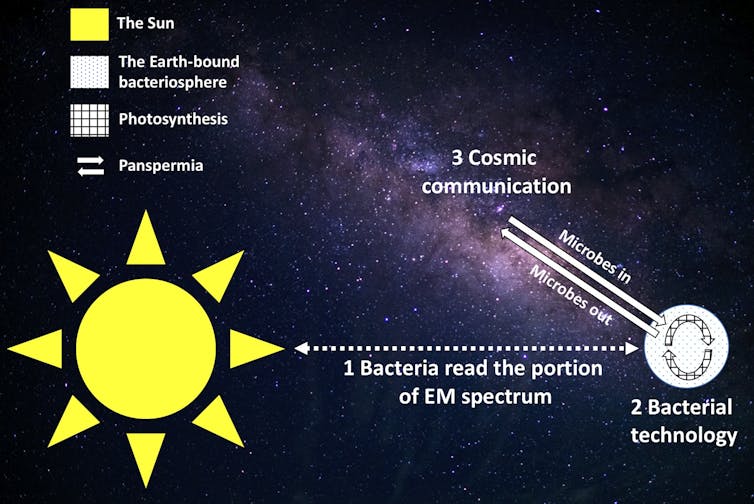
Our depiction of Microbial SETI.
Bacteria, for example, live as member societies of several billion colonies capable of thinking and decision-making.
A typical bacterial colony is a cybernetic entity a superbrainthat solves environmental problems.
More importantly, all bacterial colonies on Earth are interconnected into a global bacterial supersystem dubbed the bacteriosphere.

For example, they cycle important nutrients such as carbon, nitrogen and sulfur.
Even today, bacteria are themost dominant living beings on Earth.
Take bacteria out of the biosphere, and life will gradually collapse.
Bacteria may therefore be far more suited for cosmic travel and communication than us.
Arecent studyfound that terrestrial bacteria can survive in space for at least three years, possibly more.
It’s free, every week, in your inbox.
Microbial SETI
How could the microbial SETI work?
We believe that the bacteriosphere could potentially replicate all steps known from human SETI.
Step one in human SETI is the capacity to read cosmic-scale information.
For example, using radio telescopes we can analyze distant habitable planets.
Step number two is to develop technologies and knowledge to assess whether habitable planets contain life.
Our version of microbial SETI is shown in the picture below.
Microbes have a limited capacity to read the cosmic-scale information.
This transformed the dead planet into a living one, or the bacteriosphere, over a long evolutionary period.
Microbial life then got more complex, creating plants and animals in the past 600 million years.
Yet bacteria remain the most dominant life form on the planet.
Photosynthesis, as a form of bacterial technology, has always fueled life on Earth.
Step three is all about attraction and communication between microbes with similar chemistries.
The opposite process is also possible.
Microbes from Earth could travel into space on asteroids and seed life elsewhere in the cosmos.
To appreciate microbial SETI, we need to understand the concept of intelligence in the evolutionary sense.
We also need to reevaluate technological signatures as signs of intelligent civilizations.
Technologically advanced civilizations, according to the physicistFreeman Dyson, must have huge energy demands.
But, if human-like civilizations are indeed rare, there is no point insearching for such structures.
Instead, it may be more appropriate to search for biosignatures as signs of microbial life on habitable planets.
Yet we have no choice but to keep trying.
