The double helix of DNA is one of the most iconic symbols in science.
The power of the helix
DNA is not the only helix in nature.
Some bacteria, such asspirochetes, adopt helical shapes.
Even thecell walls of plantscan contain helically arranged cellulose fibers.
Muscle tissue too is composed of helically wrapped proteins that form thin filaments.
40% off TNW Conference!
This versatility in achieving complex shapeshifting may hint at the reason for the prevalence of helices in nature.
My colleagues and I discovered a simple way to make powerfulrotating artificial muscle fibersby simply twisting synthetic yarns.
Shrinking the fiber caused the fibers to re-twist.

Read more:Show us your (carbon nanotube artificial) muscles!
Wedemonstratedthat these fibers could spin a rotor at speeds of up to 11,500 revolutions per minute.
The key was to confirm the helically arranged filaments in the yarn were quite stiff.
When the filaments are too stiff to stretch, the result is untwisting of the yarn.
Learning from DNA
More recently, I realized DNA molecules behave like our untwisting yarns.
We also see supercoiling in everyday life, for example when a garden hose becomes tangled.
Supercoiling for stronger artificial muscles
Our latest results showDNA-like supercoilingcan be induced by swelling pre-twisted textile fibers.
Swelling the hydrogel by immersing it in water caused the composite fiber to untwist.
But if the fiber ends were clamped to stop untwisting, the fiber began to supercoil instead.
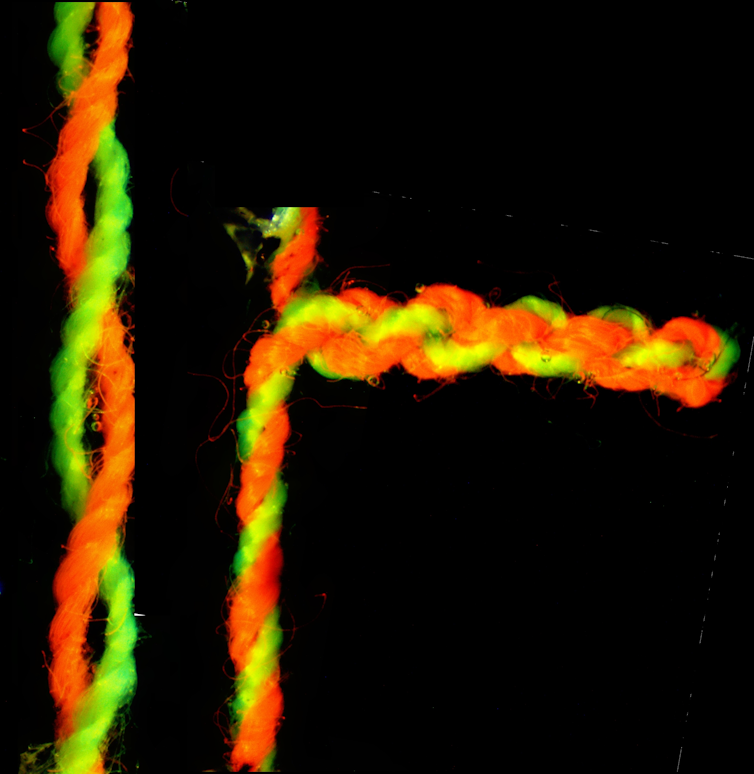
An untwisted fiber (left) and the supercoiled version (right).
Why artificial muscles?
Artificial muscle materials are especially useful in applications where space is limited.
However, artificial muscles maintain a high work and power output at small scales.
To demonstrate their potential applications, we used our supercoiling muscle fibers to open and close miniature tweezers.
Such tools may be part of the next generation of non-invasive surgery or robotic surgical systems.
Many new types of artificial muscles have been introduced by researchers over the past decade.
This is a very active area of research driven by the need for miniaturized mechanical devices.
