Disclaimer: this is not an ad for Obsidian.
Onboarding to a new company is hard work.
Keeping all the information straight is its own work stream that deserves thought and attention.

Countless names, faces*, teams, initiatives, and acronyms fly by before noon.
Im in the process right now.
This week I landed on a system Im pretty happy with.
Youre a knowledge worker.
Build a knowledge base
You need a place to put all the information youre receiving.
This is some of the stuff Im talking about:
I recommendObsidian.
Its essentially a markdown editorbut its so much more than that.
It works off of your local filesystemno cloud-based privacy concerns.
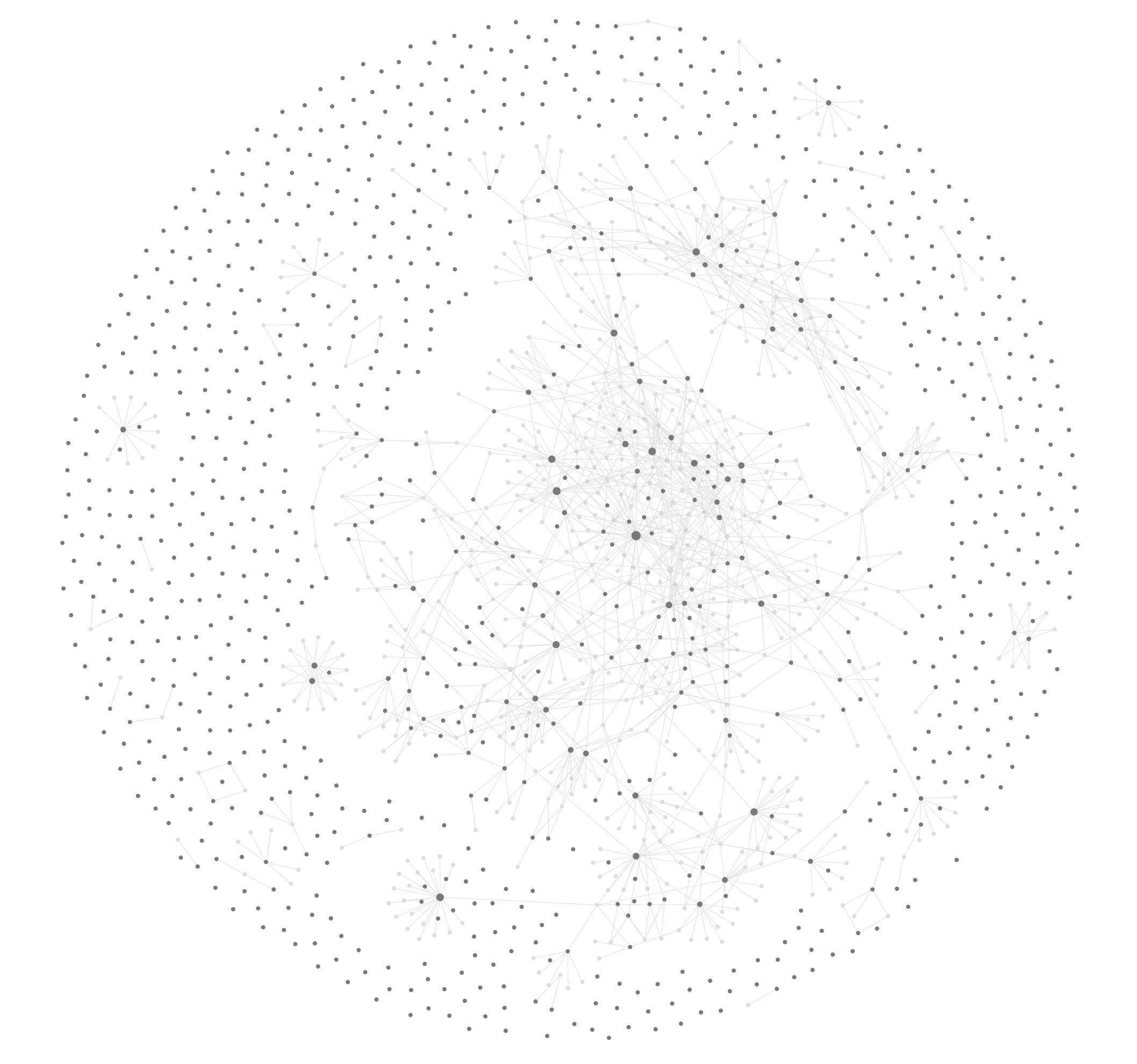
It encourages you to create a dense knowledge internet with many links and tags.
It also has a rich set ofofficialandcommunity plugins.
40% off TNW Conference!
But, you dont have to build your knowledge base manually.
Try seeding from available data sources.
Engineering wiki
Does your organization have an engineering wiki on GitHub?
Clone it and dump it right into your Obsidian folder.
Now you have tons of pages instead of a blank slate.
You are your companys foremost export on onboarding.
you could use your vantage point to make the next hires onboarding experience better.
Contribute to the wiki as youre onboarding.
Make it less confusing.
I recommend checking out a branch of the repo so that any changes you make are PR-able.
One really easy change that adds a ton of value is just adding hyperlinks.
Theres often an obscure page describing something that doesnt have any links going to it.
Hyperlinks are a better discovery tool than grep, so add them.
Github repos
Add a markdown file in your knowledge base for every repo at your org.
If you use GitHub, download the GitHub CLI.
They are ordered by most recent commit.
I wrote a little node script to generate markdown files too.
People and teams
This one is harder to make generic.
Your source of truth might be Slack, GitHub Teams, or something totally different.
you could also add people manually.
Version tracking
Use git.
Git init in your Obsidian directory.
We use git for everything else, why not our knoledge base?
Commit at the end of every day and take a look at the diff.
Write a real commit message.
Dont worry about length.
Just verify you have a .gitignore file.
In my case I ignore my eng-wiki directory so I dont have to deal with git submodules.
Diagrams
A picture is worth 1000 words.
Heres how I do pictures.
Excalidraw
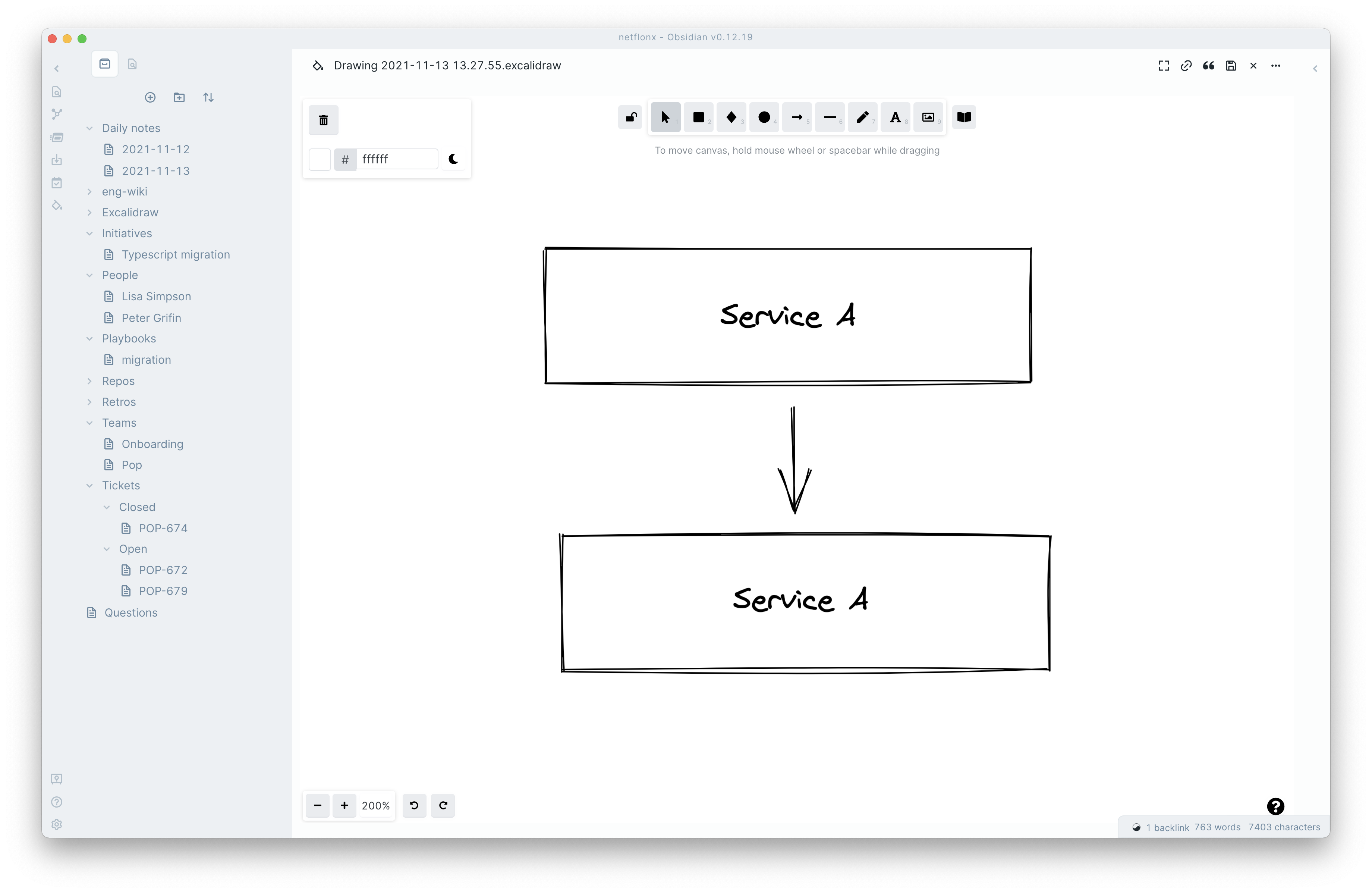
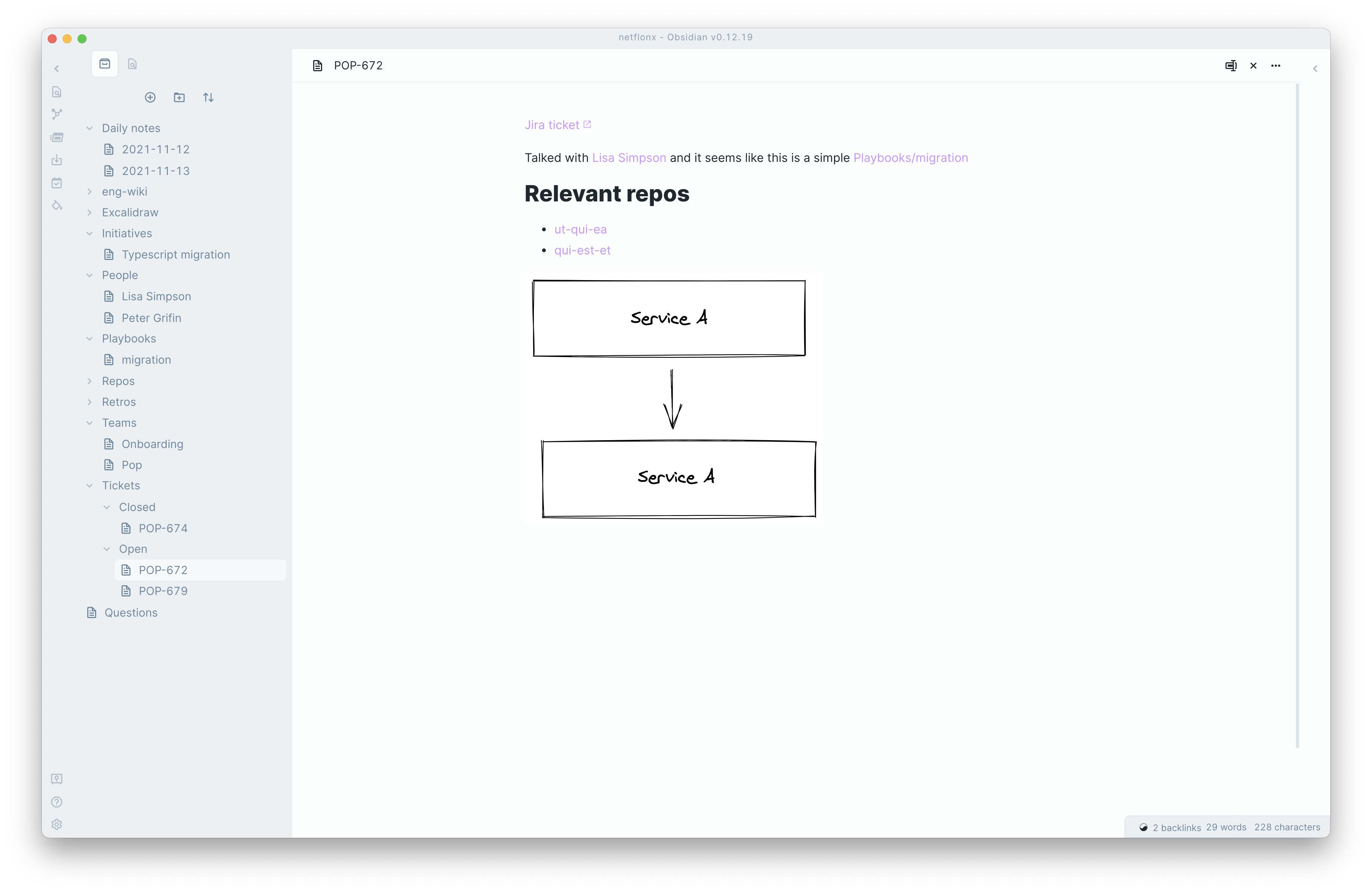
Theresan Excalidraw pluginfor Obsidian (thanks @zsviczian!).
Ive already written abouthow much IloveExcalidraw.
The fact that Obsidian can elegantly integrate with Excalidraw is amazing.
When I say elegantly, I mean it.
you could link from inside diagrams to pages inside your knowledge base.
you’ve got the option to embed.
Mermaid
Excalidraw is a great general purpose diagraming tool.
But, for highly structured diagrams,Mermaidis sometimes better.
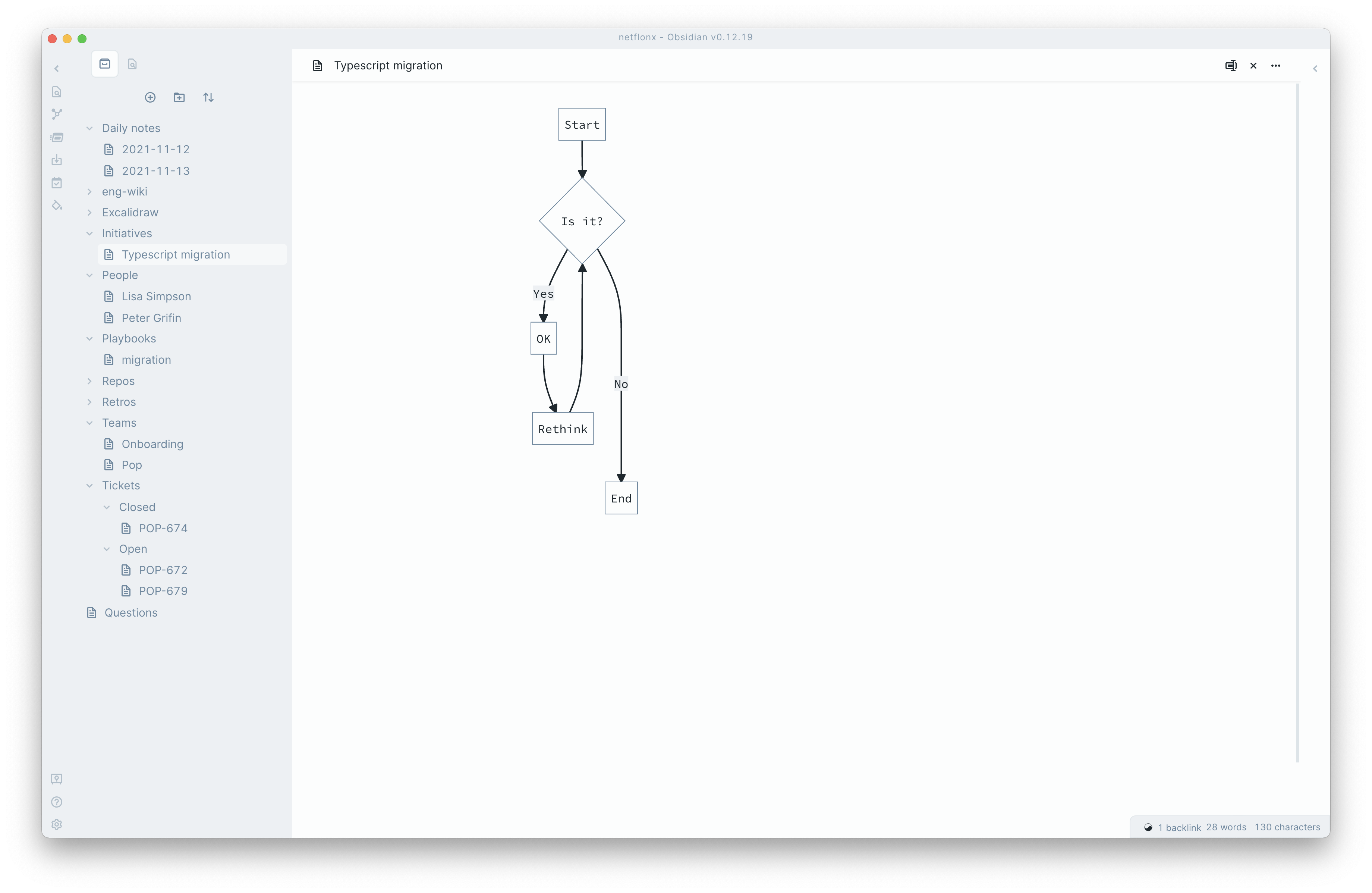
Obsidian has native support for Mermaid diagrams.
Just make a code block annotated as mermaid.
Heres an example from their docs.
Questions
1,000,000 questions will come up every day.
There wont always be time to ask them.
Some of them you’re free to look up.
I recommend making a system for these.
I made a central questions page.
When things come up on other pages, I link to my questions page.
That way, when I want to review open questions, I can go look at all the backlinks.
Every day take a look at open questions.
Look through the company wiki, or other sources of truth.
Answer: [[eng-wiki/code-review-process]] goes into this.
double-check the answers make their way back into your knowledge base.
Daily notes
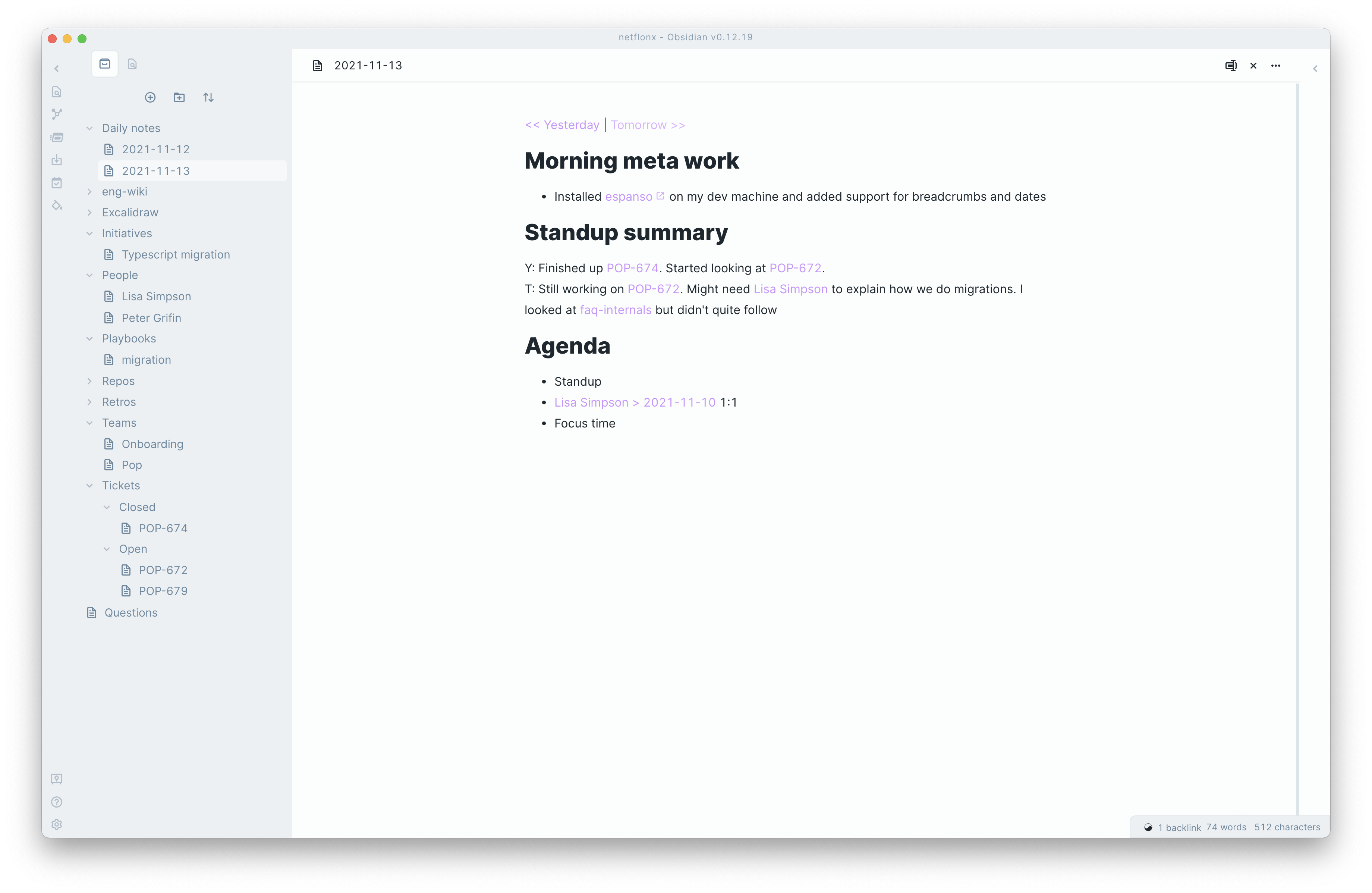
Obsidian has adaily notes pluginthat is very useful.
I always include a meta section for observations about how the system is serving me.
I also recommend creating links referencing thenext and previous day.
I find that daily notes end up accumulating a ton of random stuff that came up that day.
Take a little time to ask yourself if content on the daily note page should be relocated.
My tickets directory isnt flat.
Many of the tasks you complete when youre new on the job are somewhat rote.
Youre not re-architecting the home page in week one.
For these repeatable tasks, is there good documentation about how to do it?
Itll make it easier to do next time.
If your playbook describes something beyond just you and your team, add it to the eng-wide wiki.
They call it research debt.
I think of it assemantic debtorcognitive debt.
Reflective writing is a good way to prepare your brain for synthesis.
When you write reflectively.
Dont worry about formatting and linking while you free write, it could get in the way of flow.
Once youre done, see if there are links to add or formatting to apply.
*It doesnt help that I have prosopagnosia!
This article fromOff-by-oneis a stream of thought about computers.
The author, Zeke Nierenberg, writes about programming, education, tech-enabled thinking tools, and product development.
Find the original articlehere.
