Imagine its your first time entering a social virtual reality experience.
You quickly set up an avatar, choosing feminine characteristics because you identify as female.
You choose an outfit that seems appropriate, and when youre done, you spawn into a space.

You have no idea where you are or who is around you.
You try blocking them, but you dont know how.
You remove your headset fearing that you dont belong in this community.

40% off TNW Conference!
This article is the product of our journey.
The illusory virtual self
So why did we feel like weneededto take action on social VR harassment?
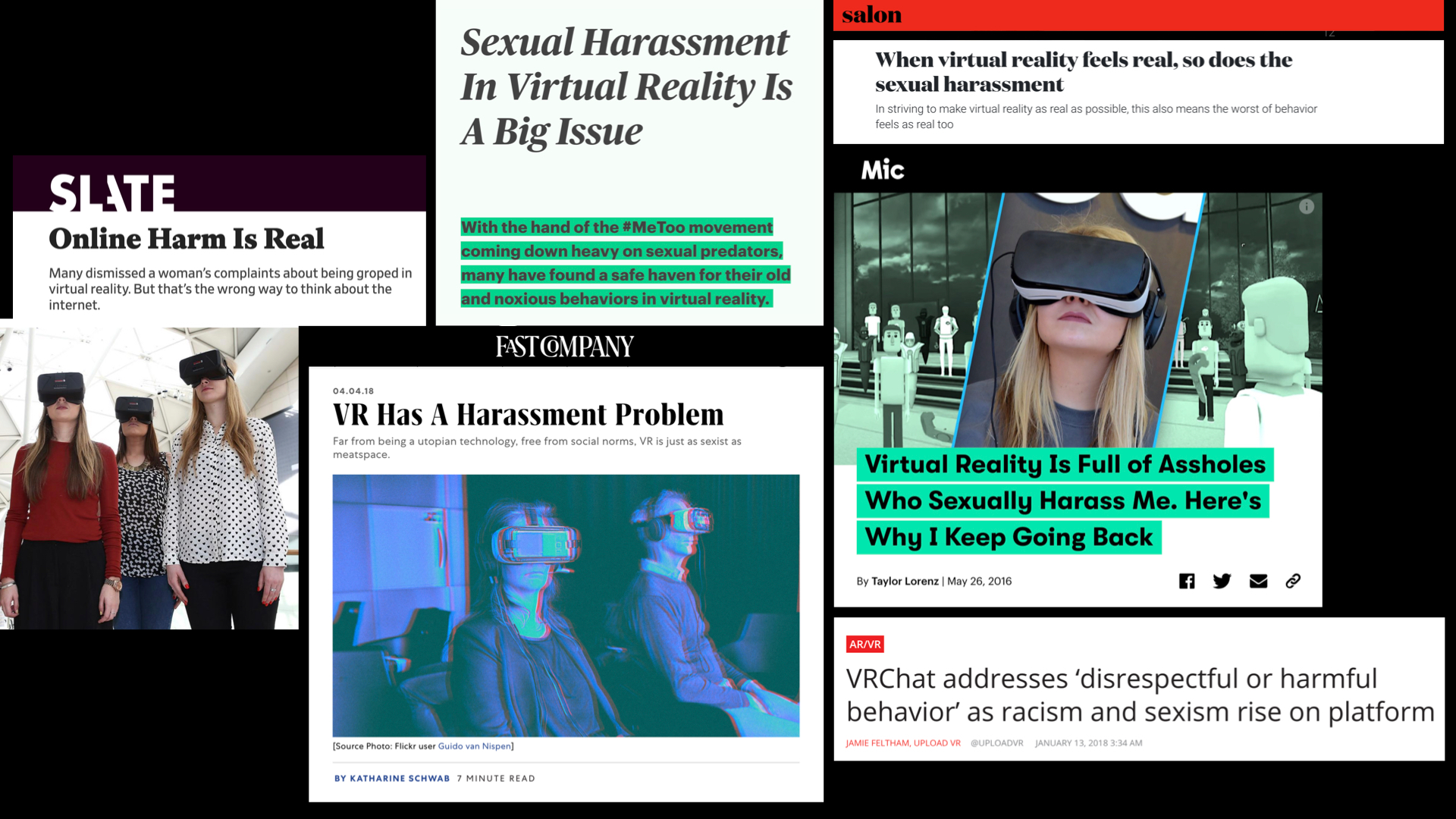
Because when youre in VR, interactions can feel real.
This sensation of experiencing a virtual body as your own is called virtual embodiment.
This is an example of how the brain can form a connection to a foreign body.

The visceral quality of VR abuse can be especially triggering for survivors of violent physical assault.
According to Abraham MaslowsHierarchy of Needs, feeling safe is a basic human right in any place.
Safety and inclusion need to be virtual status quo.

- While for men, this isnt something they think about; their go-to answer was, Nothing.
Visions of Female Sexual Power and A World Without Rape(Berkeley: Seal Press).
By empowering people with easy-to-understand social norms, accessible tools, and appropriate behavior engagement.
In our day-to-day lives, there is etiquette in how we interact with people.
You dont wear your pajamas in public.
You dont skip the line or cut somebody off in traffic.

And, if this does happen you could take action to stop that behavior.
to make it bring equity to VR would would have to pull in real world conduct expectations.
Hall divides experiences into zones of distance from the body.
Proxemics can be viewed as four distinct categories: intimate, personal, social, and public.
The boundaries of these zones help us understand appropriacy at various distances.
We can use these zones to help people understand what behavior is appropriate at specific times and locations.
This results in inspiration for consent introspection, tailored to each zone the architecture of our code of conduct.
Intimate space
Lets begin with the nearest zone: intimate space.
In the real world, an example of this would be a bedroom.
The inspiration for this comes from the real-world intimate consent paradigms found in Yes, No, Maybe charts.
These individuals would then share these lists with each other before engaging in any precarious intimate acts.
Personal space
Next, lets look at personal space.

In the real world, an example would be a living room or other shared household space.
Designers should incorporate simple communication gestures and easy-access shortcuts to allow their users quick-action remediation in tough situations.
These simple shortcuts can allow users to quickly report a problematic experience without interrupting or further degrading their experience.
We designed the upcomingFacebook Horizonwith easy-to-access shortcuts for moments when people would need quick-action remediation in tough situations.
A one-touch button can quickly remove you from a situation.
Our example of local behavior codes is from the [now-defunct] social VR app,Facebook Spaces.
Public space
And finally, public spaces.
To ensure inclusivity in public virtual spaces, we can look to real-world law systems for inspiration.
Specifically the real-worlds definitions of consent, evaluations of public behavior violations, and criminal consequences.
We should consider comparably universal rules and persistent consequences for virtual violation and harassment.
By pushing timely consequences to violators, these systems reinforce conduct expectations.
Even if the real reality we inhabit often fails to do so.
This article was originally published onImmersebyAndrea ZellerandMichelle Cortese.
Zeller is a virtual and augmented reality communication designer.
She began her career as a filmmaker and now designs for Facebook.
She helped grow the content strategy discipline to writing beyond the screen at the University of Washington.
Her work focuses on applying storytelling and ethical communication patterns to participatory experiences.
Corteseis a Canadian virtual reality designer, artist, and futurist.
She splits her professional time between working on Facebook Horizon and teaching at NYU Steinhardt.
