Quick, define the word metaverse.
There are now myriad articles on the metaverse, andthousands of companies have invested in its development.
From climate change to global connection and disability access to pandemic response, the metaverse has incredible potential.
Gatherings in virtual worlds have considerably lower carbon footprints than in-person gatherings.
People spread all over the globe can gather together in virtual spaces.
The metaverse can allow disabled peoplenew forms of social participation through virtual entrepreneurship.
No lessmonumental dangers exist as well, from surveillance and exploitation to disinformation and discrimination.
40% off TNW Conference!
As aprofessor of anthropologywho has been researching the metaverse for almost 20 years, I know this confusion matters.

The metaverse is at a virtual crossroads.
Norms and standards set in the next few years are likely to structure the metaverse for decades.
But without common conceptual ground, people cannot even debate these norms and standards.
Unable to distinguish innovation from hype, people can do little more than talk past one another.
This leaves powerful companies like Meta to literally set the terms for their own commercial interests.
The problem is that humans dont categorize by laundry lists.
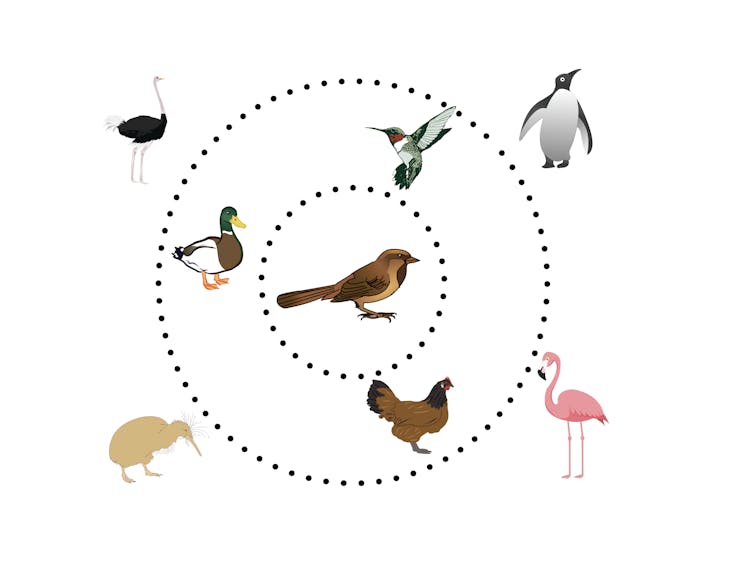
Instead, decades of research in cognitive science has shown thatmost categories are radial, with a central prototype.
But the prototypical bird for North Americans looks something like a sparrow.
Hummingbirds and ducks are further from this prototype.
Further still are flamingos and penguins.
Yet all are birds, radiating out from the socially specific prototype.
Someone living near the Antarctic might place penguins closer to the center.
Human creations are usually radial categories as well.
If asked to draw a chair, few people would draw a dentist chair or beanbag chair.
Virtual worlds are prototypical for the metaverse.
Other elements of the laundry list radiate outward and wont appear in all cases.
And whats involved will be socially specific.
Whose idea of essential?
For instance, many pundits define the metaverse asbased on blockchain technologyand cryptocurrencies.
But many existing virtual worlds use means other than blockchain for confirming ownership of digital assets.
Many use national currencies like the U.S. dollar, or metaverse currencies pegged to a national currency.
In many cases, fragmentation is desirable.
This raises the question of why Meta and many pundits are fixated on interoperability.
Recognizing metaverse as a radial category reveals that Cleggs claim about interoperability isnt a statement of fact.
Its an attempt to render Metassurveillance capitalismprototypical, the foundation of the metaverse.
It doesnt have to be.
Locking in definitions
This example illustrates how defining the metaverse isnt an empty intellectual exercise.
Its the conceptual work that will fundamentally shape design, policy, profit, community and the digital future.
They become digital common sense.
