TheBitcoin bear markethas battered and bruised a multitude of blockchain startups.
But somehow, a Matrix-themed cryptocurrency, NEO, is hiring.
The second iteration ofNEO DevContook place in Seattle over the weekend.

The most notable announcement was theopening of a new officein the famously tech-orientated Washington capital.
Its to be spearheaded by John deVadoss, former director of engineering for Microsofts .NET framework.
He also served as general manager of Microsoft Digital, and oversaw the majority of its product lifecycle.
40% off TNW Conference!
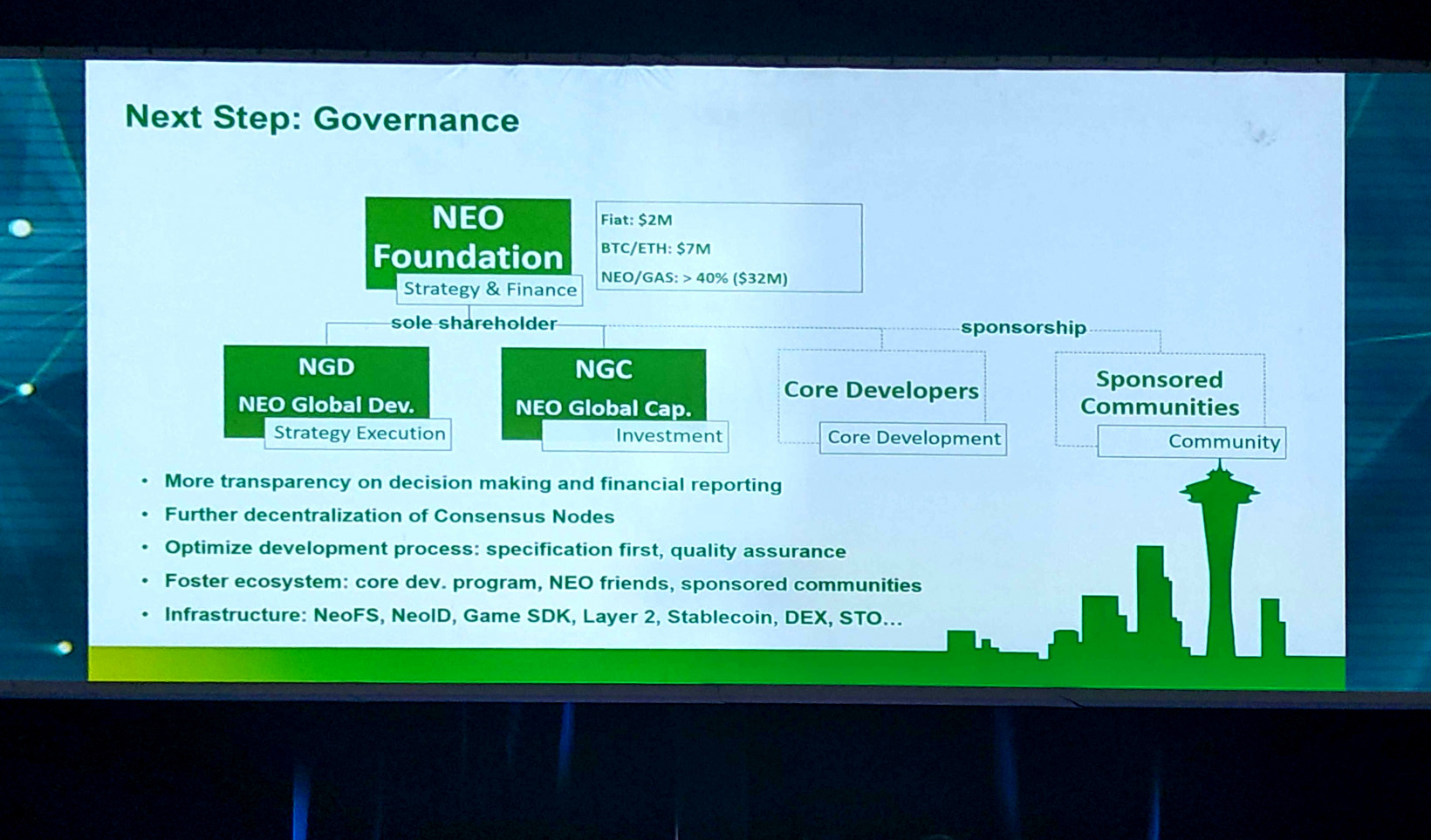
The NEO Foundationmaintains its development.
Its a non-profit providing tools for building decentralized platforms, like games, exchanges, and other token-oriented services.
At a high level, dBFT is reminiscent of another consensus model,Delegated Proof-of-Stake(DPoS).
Its employed by rival blockchains EOS and TRON, which have 21 and 27 validating nodes respectively.
Bitcoin currently hasmore than 10,000 full nodesworking on securing its blockchain, while Ethereumhas just under 9,000.
More generally, if roughly 66 percent of the online grid agrees, the transactions are treated as legitimate.
It also means trusting a very small set of individuals to not get up to any funny business.
The differences between DPoS and NEOs dBFT, though, extend a little further.
With DPoS, participants can use their account balance to elect third parties to validate the data pipe.
The more tokens held, the more sway can be used to select who should be running the show.
I would focus more on the underpinnings of the blockchain.
For example, you look at PoW.
I think that this notion of probabilistic finality might make sense for Bitcoin.
I mean, you have to have absolute finality.
DeVadoss went on to say this gives NEO a unique advantage.
He also noted Ethereum was looking toshift consensus stylesaltogether, andhad already faced problems.
So, you look at, for example, Ethereum.
They have to now go from PoW to PoS theyve had some hiccups along the way, he continued.
In fact, the attention NEO has paid to Microsoft is no joke.
This was something he noted the software giant appreciates greatly.
We want to be seen as a serious platform trustworthy, developer-friendly and ready.
He then noted NEO would not be changing consensus styles or protocols any time soon.
But, with 3.0, we are exploring new or better governance models.
We need to incentivize NEO token holders to take part in the election (or delegation) process.
When pressed on what some of those incentives might be, Hongfei maintained it was still under discussion.
A few different proposals are being considered, but no conclusion has been made as yet.
In the past, we took the process of code first, so theres no specification.
We discuss, we have some idea, we write a white paper and then directly go to coding.
The need for explicit guidelines is understandably necessary, especially from a software engineering point-of-view.
You cannot say, I want this feature, I want it done by this date.
But sometimes, its not done by yourself.
You have to delegate to other core developers, or to a community like City of Zion.
Hongfei says it is currently operating at a profit.
The only revenue we have is from NGC.
We actually have new offices.
The number of employees at NEO Global Development grows linearly, very steadily, from four to todays 45.
You know, were not being too aggressive, even during the bull market.
Were not hiring 300 developers, then laying off two-thirds of them.
Were not doing that, he added.
So, I will encourage people to devote more of their time to working on infrastructure.
It depends on what kind of developer it is.
Some [developers] out there will like Ethereum, and some will like NEO, he suggested.
If you are a C# or .NET developer, you will like NEO.
Definitely, developers challenge us over having just seven consensus nodes, Wang continued.
He’s currently on the finance beat.
