Leading the effort to develop Content Optimizer is John Wolf, Product Manager of Smart Content at Mailchimp.
Wolf was the founder of Inspector 6, a startup acquired by Mailchimp in 2020.
The vision for AI-powered content marketing
40% off TNW Conference!

Like all companies, Intradiem needed great marketing content.
But the process was difficult, and measuring quality and success was very subjective.
The creative process was completely dominated by opinions with little data.

At the time, machine learning was starting to find real business applications in many sectors.
So, Wolf started to think about using ML to optimize the creative process for content marketing.
The idea was, what if we could use machine learning to understand marketing content?

In 2017, Wolf founded Inspector 6 with the vision of developing AI-powered content marketing.
Inspector 6 became an AI platform that analyzes marketing content to deliver insights and recommendations for improvement.
Accordingly, Inspector 6s platform was successful in some areas and met challenges in others.

And I found that it wasnt necessarily true, Wolf said.
Before Mailchimp acquired Inspector 6, the two companies entered a partnership.
Recommendations also require context.

Likewise, machine learning models require context.
Inspector 6 had architected its technology as individual microservices on Amazon Web Services.
The system ingests a marketing asset, and the individual microservices independently do their job to analyze it.

Mailchimp, on the other hand, uses the Google Cloud Platform.
So, the services had to be transferred from one cloud platform to another.
This made it much easier to integrate Inspector 6s services into Mailchimps cloud infrastructure.
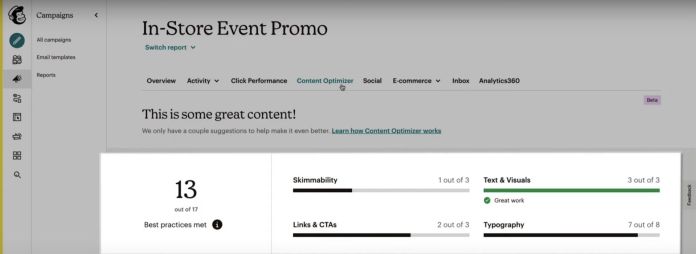
Inspector 6s microservices are an enabling technology.
They are integrated into the backend of Mailchimps system and offered through frontend products.
All users can enter the content scorecard.
Premium users also get actionable recommendations to improve their content.
Our north star in solving this problem is improving campaign performance.
Naturally,machine learningis a key component of Content Optimizer.
In some areas, Content Optimizer combines ML predictions withsymbolic AIto provide recommendations that are more robust and understandable.
For example, a call to action is a key component of any marketing asset.
Most successful call-to-action sentences start with a verb of a certain form.
That business rule performs very well, the Content Optimizer team found.
Human oversight
While the machine learning models provide valuable insights, they cant work autonomously yet.
We go through a traditional predictive modeling exercise, but then theres a manual vetting process, Wolf said.
That creates inefficiency in the process, but we feel its necessary at this point.
There is some controversy around putting human operators behind AI systems.
Sometimes, its called the Wizard of Oz technique or pseudo-AI.
Moreover, the company is not outsourcing the task and is carrying it out entirely through internal resources.
It adds a labor-intensive element.
But its an area were willing to put people against, Wolf said.
Its not guaranteed that the task will be fully automated.
A notable example in this regard is AdWords, Googles online advertising platform and its greatest source of revenue.
Learning from users
One of the key parts of the product management process is learning from users.
After launching a product, your hypotheses will be put to test.
They also found that many marketers struggle with writing simple and concise language.
Sometimes theyll surprise you with what theyre great at and what theyre still struggling with.
and How is it done?
Theyve taken the product and understood it really well, Wolf said.
The product will also expand from email marketing to other channels such as web pages and social media.
The touchpoints will also increase in the future.
Wolf is also interested in getting into computer-generated content in the future.
Even the most sophisticated marketers in the world would love to spend less time generating content, he says.
Everyone is familiar with cutting-edge copywriting generative models likeGPT-3.
Generative modelsstruggle with consistency and coherencewhen used in isolation.
Our customers spend 28 million hours a year writing copy alone, not even designing and sourcing images.
We think with some technologies in the generative space, we can decrease that by 80 percent.
Thats 22 million hours we can save our customers, he said.
Were really excited about what the future holds and were really just getting going.
you might read the original articlehere.
