Technology has become increasingly intrusive.
In 2018, though, we can hardly imagine living without one.
Willingly integrating technology into your body, or biohacking, therefore seems like the next logical step.
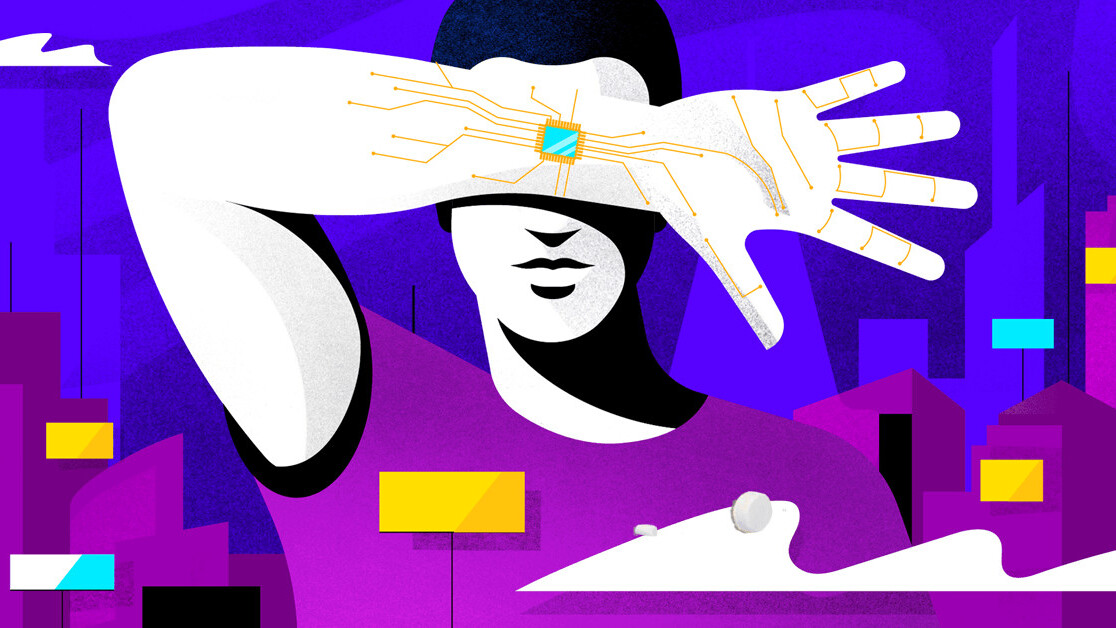
Many expect the next logical progression in personal technology to be wearable.
Why carry a distracting smartphone when the power of the internet can be harnessed by some lenses?
This is known as biohacking, and there is already a community of those dedicated to the practise.
Binary District Journal spoke to Kevin Warwick, leading expert in cybernetics and Deputy Vice-Chancellor at Coventry University.
40% off TNW Conference!
From a scientists point of view, its always the difficult one to call, he says.
Because you know the technology is there.
The first thing is, when will the first experiments happen?
They could happen at any time.
So thats point one:there needs to be a scientific step, but it could happen now.
Then, the question is how quickly does it get developed?
OK, you could have a telephone, but you couldnt call anybody because nobody else had a telephone.
It needed that web link and it needed commercial enterprises coming in.
Also, it needed society to need it and want it.
Those are difficult calls.
Then, people might get excited about it, while still being worried about potential risks.
So, to say In 50 years time well have this is a very arm-waving thing.
It could be 10 years, it could be 100 years.
There have been a number of pioneers, with wildly varying degrees of success.
The stunt made waves, inciting equal parts intrigue and vitriol.
To him, the herpes cure was nothing more than a bad PR stunt.
Ascendance Bio are not legit in any measure.
They have created no cures.
Perhaps the most famous biohacker is Neil Harbisson.
Born completely colorblind, the Catalan-raised 34-year-old was the first person to have an antenna implanted into his skull.
There is a particularly active community in Pittsburgh, Pennsylvania.
Here, a quasi-anarchist, anti-corporate attitude pervades biohacking.
Biohacking is, at present, part of the body modification counterculture.
For Kevin, these people are pioneers.
We asked him if he knew that he was something of an icon in their community.
Theyre icons for me as well!
Some of it is more for artistic purposes, which is interesting.
Some of it is people doing the same as others have done, which is not so interesting.
But others, theyre trying different things, implanting in different ways, seeing what happens.
Some of it is absolutely good.
I respect what theyre doing enormously.
There are dangers associated with it.
Could our brains be hacked?
The dangers of biohacking potentially extend further than those associated with the fitting of the devices, though.
I look at the bigger picture, Kevin tells us.
There are always people worried about hacking in.
If youve got an implant in your brain, could somebody hack into your brain?
If youve got it and the implant counteracts it, they can stop that working.
Its limited, though.
The nervous system, but in particular the brain, is unbelievably complex and everybodys is differently organised.
There is a blueprint this is what your brain and nervous system are like but everybody is different.
So, its very difficult and I dont think hackers have got the background in the first instance.
Is it legal?
The legality of biohacking is interesting.
We asked Kevin how stringent regulation is and will be.
Thats a very good question, Kevin says.
I think, when you include medical professionals, then you need ethical approval.
I wouldnt say its regulation, I dont know what youd call it.
So, I think there is quite a good regulation for that.
If youre doing it yourself, though, its sort of open season.
Thats the general law.
Intellectually, that could make us superhuman.
Theres no overseeing world, or even governmental, body that says yes, no or whatever.
You get some ethical committees.
If we wanted to become super-intelligent and take over the world, essentially theres nothing stopping us doing that.
Ultimately, a mainstream future for biohacking will come down to genuinely useful use-cases.
Amal himself can unlock the door to his house with an implant fitted in his hand.
For Amal, the devices work best when there is absolutely no management.
Amal wants his products to disappear and become just a functional part of the users body.
An implant system is just ideal because its always there, he told VICE.
You never forget it.
You kind of forget about it, actually.
Its really something that doesnt interfere with your life until it’s crucial that you use it.
TNW Conference 2019 is coming!
The primary focus of the Journal is to educate and inform no hype, just facts.
