She had started noticing very weird shapes she couldnt fit easily to any known pop in of object.
None of us had ever seen anything like it before, and we had no idea what it was.
A few days later, our colleague Emil Lenc found a second one, even more spooky than Annas.
EMU plans to boldly probe parts of the Universe where no telescope has gone before.
40% off TNW Conference!
But none of us expected to discover something so unexpected, so quickly.
Because of the enormous data volumes, I expected the discoveries would be made using machine learning.
But these discoveries were made with good old-fashioned eyeballing.
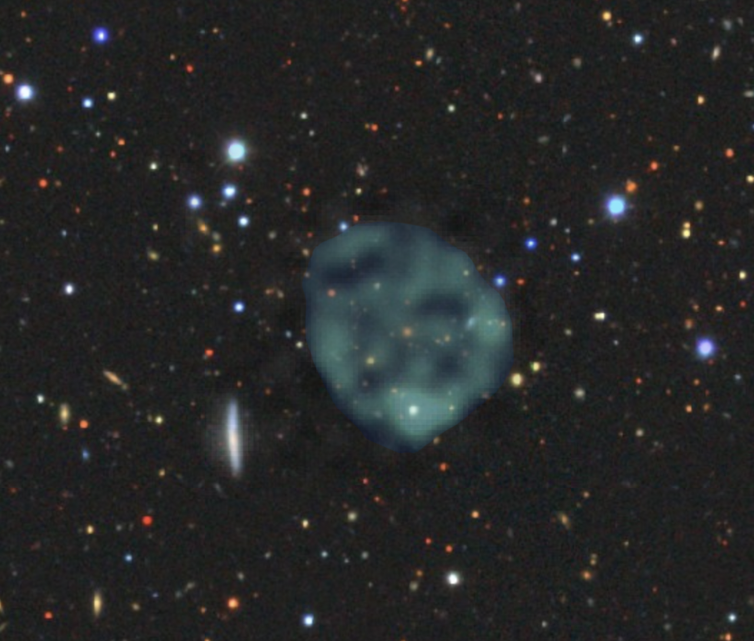
We dubbed them ORCs, which stands for odd radio circles.

But the big question, of course, is: what are they?
At first, we suspected an imaging artefact, perhaps generated by a software error.
But we soon confirmed they are real, using other radio telescopes.
We still have no idea how big or far away they are.
When we look in images taken with optical telescopes at the position of ORCs, we see nothing.
We dont know, but finding a puzzle like this is the dream of every astronomer.
We know what theyre not
We have ruled out several possibilities for what ORCs might be.
Could they besupernova remnants, the clouds of debris left behind when a star in our galaxy explodes?
They are far from most of the stars in the Milky Way and there are too many of them.
Could they be the rings of radio emission sometimes seen in galaxies undergoing intensebursts of star formation?
We dont see any underlying galaxy that would be hosting the star formation.
ORCs are too symmetrical, and we dont see a cluster at their center.
Or perhaps they are something else entirely.
Two Russian scientists have evensuggestedORCs might be the throats of wormholes in spacetime.
From the handful weve found so far, we estimate there are about 1,000 ORCs in the sky.
Its a tricky job, because ORCS are very faint and difficult to find.
Its an exciting time for us.
Most astronomical research is aimed at refining our knowledge of the Universe, or testing theories.
Is it a completely new phenomenon, or something we already know about but viewed in a weird way?
And if it really is completely new, how does that change our understanding of the Universe?
