Prior to the pandemic70%of office-based employees worked in open-plan offices.
Employee complaints about this design arerife.
40% off TNW Conference!
We varied the order of the sound tests to avoid bias due to fatigue and training effects.
This repeated measures experimental designallowedus to make causal conclusions about the effects of the noise on well-being indicators.
We used sensors to track changes in heart rate and sweat response both reliableindicatorsof physiological stress.
We usedfacial emotionrecognition software to assess emotional responses.
We also had participants self-report their own feeling using amood scale.
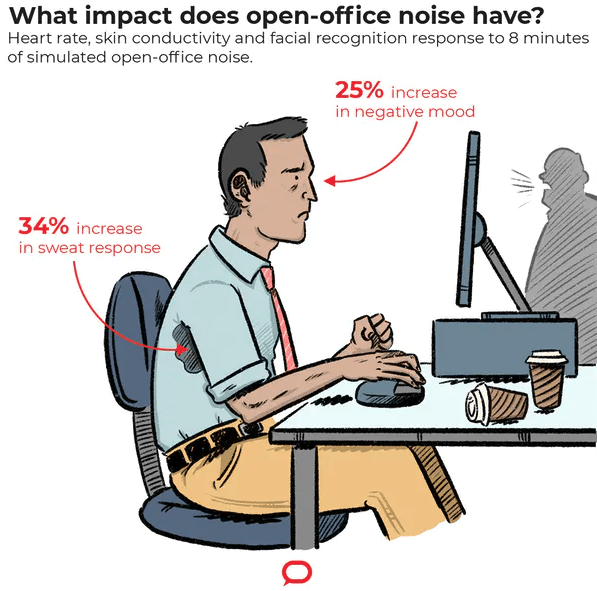
Negative mood increased by 25% and sweat response by 34%.

Reviewsin research in this field show past studies have tended to only use self-reported measures.
They have not used controlled experimental conditions, nor tested sound parameters.
Comparing multiple output measures has allowed us to investigate cause-effect relationships.
Chronically elevated levels of physiological stress areknownto be detrimental to mental and physical health.
Frequently being in a negative mood is also likely toharmjob satisfaction and commitment.
It potentially increases the likelihood of employees leaving.
What to do about it
The pandemic has changed our tolerance for office work.
So creating a healthy work environment is more important than ever.
As organizations seek to adapt to COVID-19, many are reconsidering how they set up and use the office.
But there are other things that can be done.
Acoustic treatments and sound-masking technologies ambient soundsdesigned to make other people talking less intrusive can help.
Good old-fashioned walls or partitions may alsoassist.
Such interventions can be costly, but so is the impact of poor office environmental qualityon productivity.
And we might all feel happier about going back to the office.
Article byLibby (Elizabeth) Sander, Assistant Professor of Organisational Behaviour, Bond Business School,Bond University.
This article is republished fromThe Conversationunder a Creative Commons license.
