The report certainly does not, as many were hoping, conclude UFOs are alien spacecraft.
Rather, it shows the task force hasnt made much progress since first being set up ten months ago.
Perhaps this is unsurprising, given its task.

It’s free, every week, in your inbox.
However, the task forces very existence would have been unthinkable to many people just one year ago.
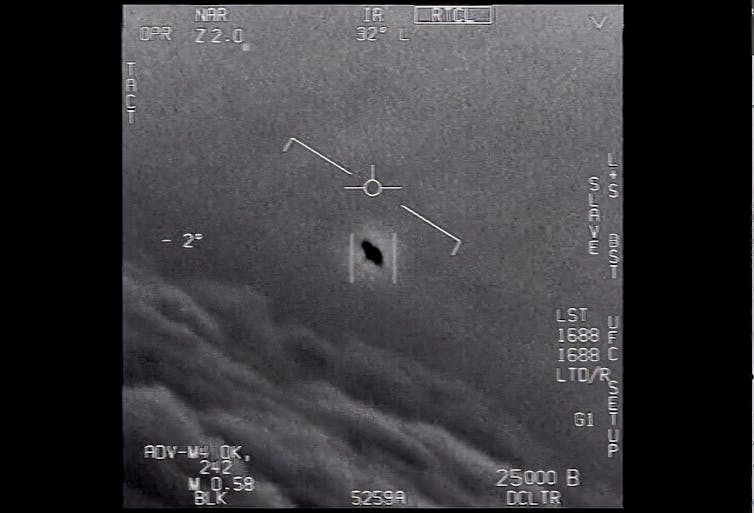
In April of last year, the US Department of Defense released three UFO videos taken by Navy pilots.

Its bombshell finding is that a handful of UAP appear to demonstrate advanced technology.
This handful 21 of the 144 reports represents classic UFO enigmas.
Sonic booms are sound waves generated by objects breaking the sound barrier.
Noknownaircraft can travel faster than sound without creating a sonic boom.
Somehave claimed the objects are probably secret, advanced Russian or Chinese aircraft.
However, global aerospace development has failed to match the flight characteristics of objects reported since the late 1940s.

And it seems counterproductive to repeatedly fly secret aircraft into an adversarys airspace where they can be documented.
How did we get here?
In 1966, the US Air Force was facing increasing public pressure to sort out the UFO problem.
Unlike the new Pentagon report, the Condon Report didnt find any UFOs that appeared to demonstrate advanced technology.
The most problematic cases were resolved by being categorized ambiguously.
Indeed, they were deliberately filtered from institutional knowledge.
The Pentagons UAP task force represents an abrupt reversal of this long-standing organizational policy.
UFO reports, made primarily by military personnel, are no longer pollutants.
They are now important data with national security implications.
That said, they do still represent uncomfortable knowledge.
As the late Oxford University anthropologist Steve Raynerobserved, knowledge can be uncomfortable for institutions in two ways.
Both aspects describe the institutional context of UFO information.
The US Department of Defence has confirmed UFOs threaten flight safety, and potentially, national security.
In doing so, it has exposed a weakness in its organizational principles.
It has admitted its not very good at knowing what UFOs are.
It also faces the criticism thatseven decadesafter UFOs first appeared on the radar, itoughtto know what they are.
The new Pentagon report doesnt compel us to accept the reality of alien visitation.
But it does compel us to take UFOs seriously.
