Elephants have long captivated our attention, partly because of their sheer size and majesty.
But were also struck bytheir complex behavior.
In some ways, were fascinated because this behavior echoes our most humane feelings.
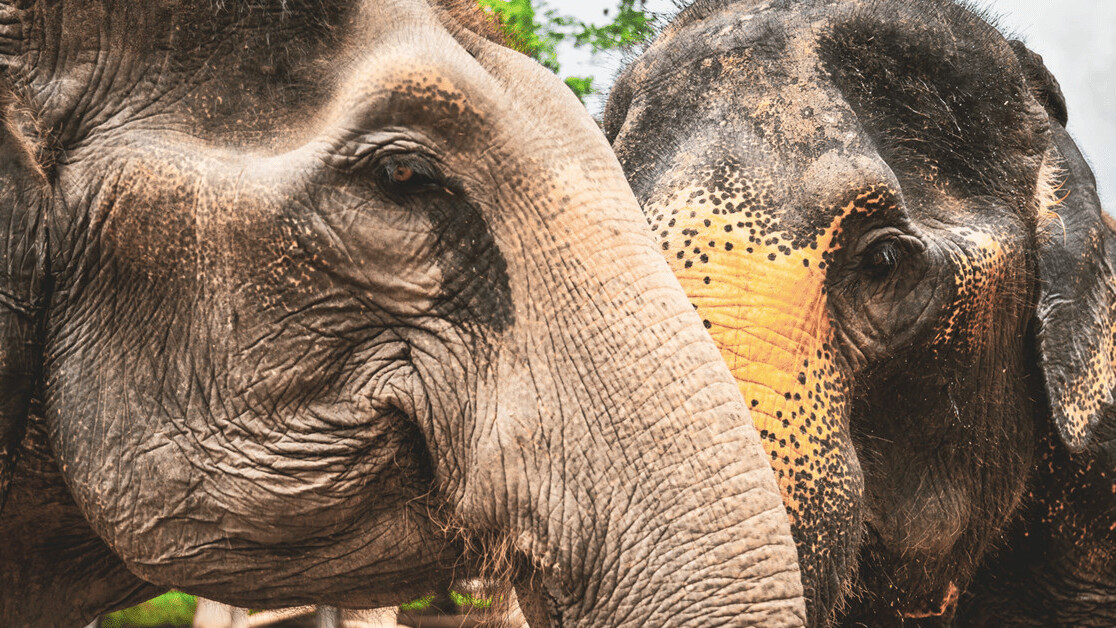
For instance, elephants have repeatedly been observed using tools andgrieving their dead.
Their evolutionary history is interesting, too.
It parallels humans in many ways.

Elephant ancestorsoriginatedin Africa, just like ours.
Their descendants, among them mammoths, went out of Africa to inhabit other continents.
And in the process they evolved the largest brain of any land animal.
It weighsaround 5kg, while our own brainsweigh 1.4kg.
But what drove this particular element of elephant evolution?
The results of this international collaborationhave been published in Scientific Reports.
And the answer to this longstanding question?
Climate change is a large part of it.
Knowing this not only solves a long standing scientific mystery.
It also means weve got a way to understand how modern species might adapt to the current climate crisis.
The encephalization quotient (a measure of relative brain size corrected for body size) doubled during each pulse.
Noticeably, these two pulses of growth in brain size correspond to periods of substantial environmental disruptions in Africa.
Africas dense rain forests turned into savannas and deserts.
The climate thenchanged againabout 20 million years ago to revert to a warmer and wetter African environment.
This climatic instability was supplemented by the appearance of a landbridge between Asia and Africa.
Before 20 million years ago, Africa was indeedan isolated continent.
The invasive fauna included the ancestors of modern-day lion, zebra, rhinoceros, hippopotamus and antelopes.
The Great Apes did not exist yet.
Some large species died out during this time; the most famous isArsinoitherium, a rhino-like relative of elephants.
Ancestral elephants had to adapt or go extinct.
A larger brain may have helped them outsmart competitors and avoid predators.
Body and brain size
Elephants were also helped by the fact that they became so big.
We found that brain size co-evolved tightly with body size in the elephantine lineage.
This suggests that the evolution of a big body is not completely independent from a large brain.
Gestation length is another (more time in the womb equals a bigger brain).
What if natural selection was acting on body size only, and brain size was just a passenger?
Answers to these questions are still pending.
But as our work progresses, the picture gets clearer.
