For many people, the most distressing part of the coronavirus pandemic is the idea of social isolation.
If we get ill, we quarantine ourselves for the protection of others.
But even among the healthy, loneliness may be setting in as we engage with pre-emptivesocial distancing.
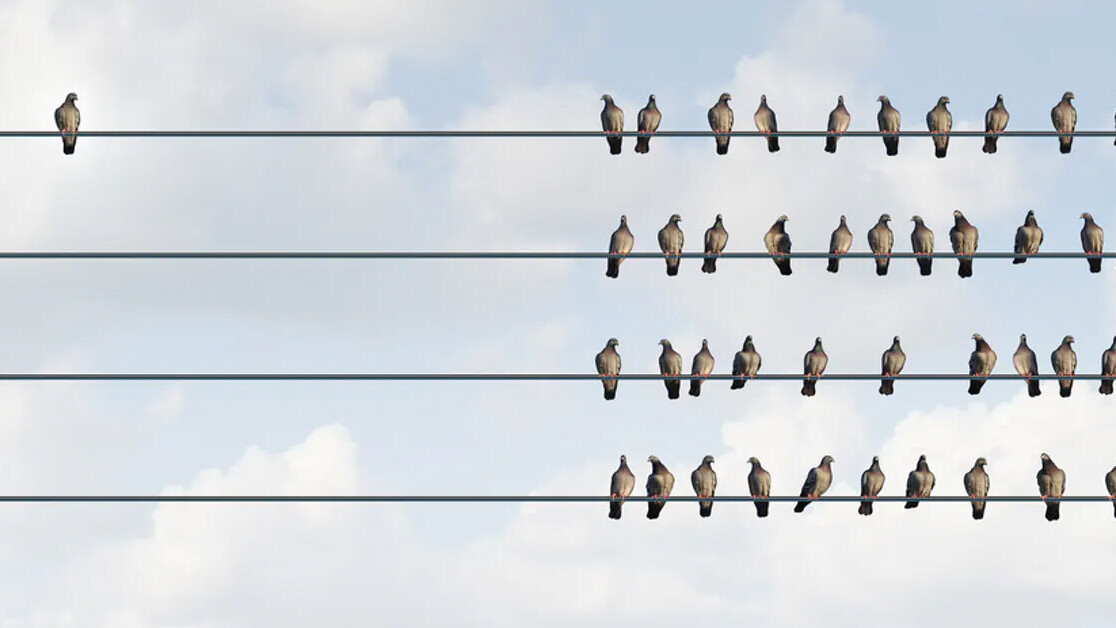
There is somegreat adviceout there about how to stay connected at such times.
But why is the act of social distancing so hard for so many of us?
The answer probably has more to do with our evolutionary history than people might think.

Humans are part of a very sociable group, the primates.
Compared to other mammals of the same body size, primates also havelarger brains.
There are several hypotheses about why this is.

Doing these things may require more sophisticated brains.
40% off TNW Conference!
Brain size in all mammals is linked to understanding and intelligence.
In primates, it is alsopositively correlated with social group size.
Living in groups requires us to understand relationships, both amicable and conflicting, with those around us.
Social skills are therefore fundamental for survival in group situations.
Human brains are even larger than those of other primates.
This prediction seems to be true.
Workplaces, for example, have been shown to function better when there areno more than 150 employees.
Living in a group offersvarious advantages.
Larger groups have better defenses against rivals and predators.
There are reproductive advantages, too.
The larger the group, the more likely any individual is to be able to find a suitable mate.
Infant primates havelots ofcomplicated social and physical skills to learn.
Finally, larger social groups have more capacity to generate, retain and transmit knowledge.
Older members are more numerous in larger groups.
This can mean the difference between survival or death.
How are we different?
All this goes some way to explaining why being socially isolated can be so very uncomfortable for us.
Modern humans are one of themost social speciesof all mammals.
As we evolved since our split with chimpanzees,our brains have continued to expand.
These increases seem to fit with even more intense reliance on the community.
The most convincing evidence, however, may come from our characteristic division of labor.
Adivision of labormeans that we allocate various specific tasks to different people or groups.
Humans employ this strategy more than any other primate.
Its not all doom and gloom, however.
We have already evolved symbolic language and huge cultural and technological capacities.
Current social distancing measures are, in fact, all aboutphysicaldistance.
But today, physical distance doesnt have to mean social isolation.
This is proof of our deep desire to be connected with each other.
