Only the last one stands up to scrutiny.
Andour latest researchhelps fill in more of the details on why.
No, no and no.

Tim Caro, CC BY-ND
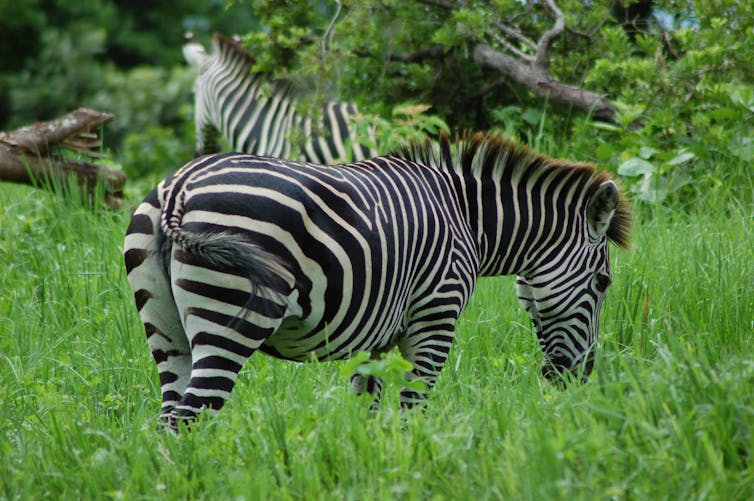
Whats the advantage of zebra stripes?
Could stripes help zebras avoid becoming a predators meal?
There are many problems with this idea.
It’s free, every week, in your inbox.
So stripes areunlikely to be of much use in anti-predator defense.
So stripes cannot be a very effective anti-predator defense against this important carnivore.

So much for the evading-predators hypothesis.
What about the idea that stripes help zebras engage with members of their own species?
Every zebra has a unique pattern of striping.
Could it be useful in individual recognition?
This possibility seems highly unlikely given that uniformly colored domestic horses canrecognize other individuals by sight and sound.
And very unusualunstriped individual zebras are not shunned by group members, and they breed successfully.
What about some kind of defense against the hot African sun?
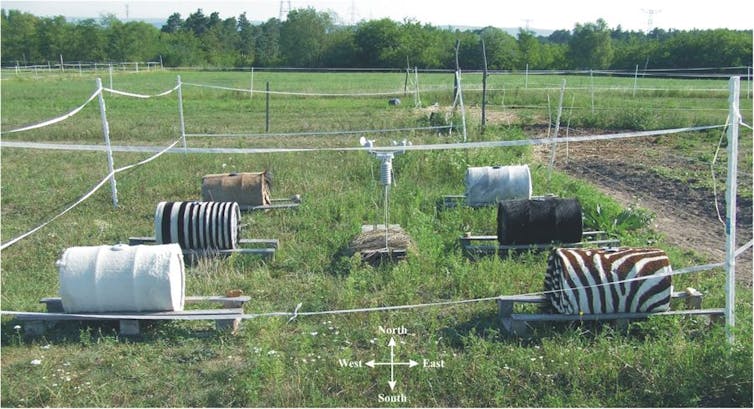
Field experiments tested how various coloring patterns affected the temperature of water-filled barrels.
Early experiments in the 1980s reported that tsetse flies and horsefliesavoid landing on striped surfacesand has beenconfirmed more recently.
Most convincingly, however, are data from across the geographic range of the seven living species of equids.
Across species and their subspecies,intensity of striping closely parallels biting fly annoyancein Africa and Asia.
And zebras areparticularly susceptible to probing by biting fly mouthpartsbecause of their short cropped coats.
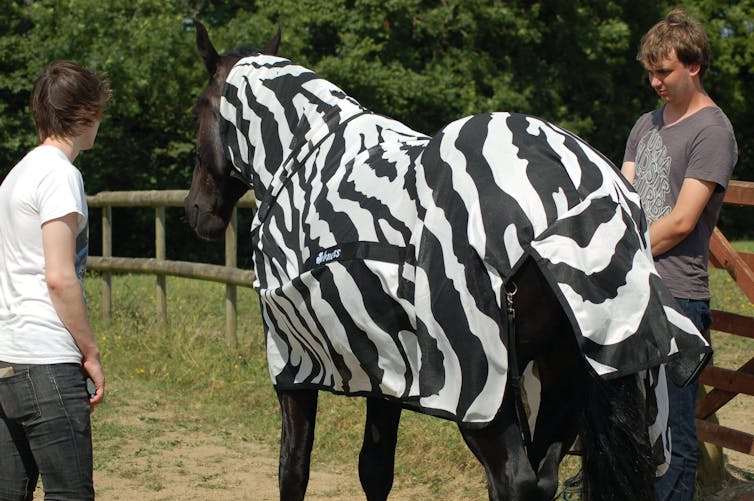
We were lucky enough to work with Terri Hill, the liverys owner.
We also videoed fly behavior around the animals, and put different colored coats on horses.
Uniformly colored horses received many more approaches and touchdowns by bothersome flies than did zebras.
Martin How, CC BY-ND
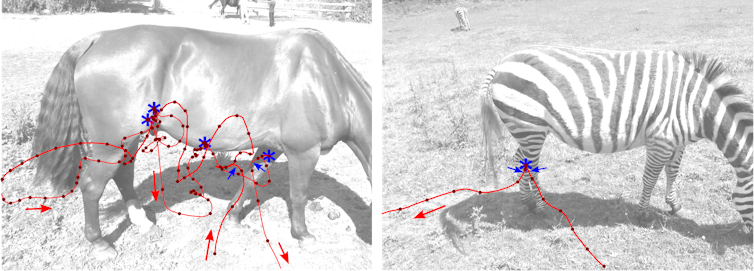
It is important to remember that flies have much poorer vision than people.
Around horses, flies hover, spiral and turn before touching down again and again.
But they failed to decelerate as they approached zebras.
Instead they would fly straight past or literally bump into the animal and bounce off.
Striped coats on plain-colored horses reduced the number of fly incursions on covered parts of the body.
And it showed us that striped horse coats, currently sold by two companies, really do work.
Only when very close do they realize that theyre going to hit a solid body and instead veer off.
We are looking into these possibilities now.
