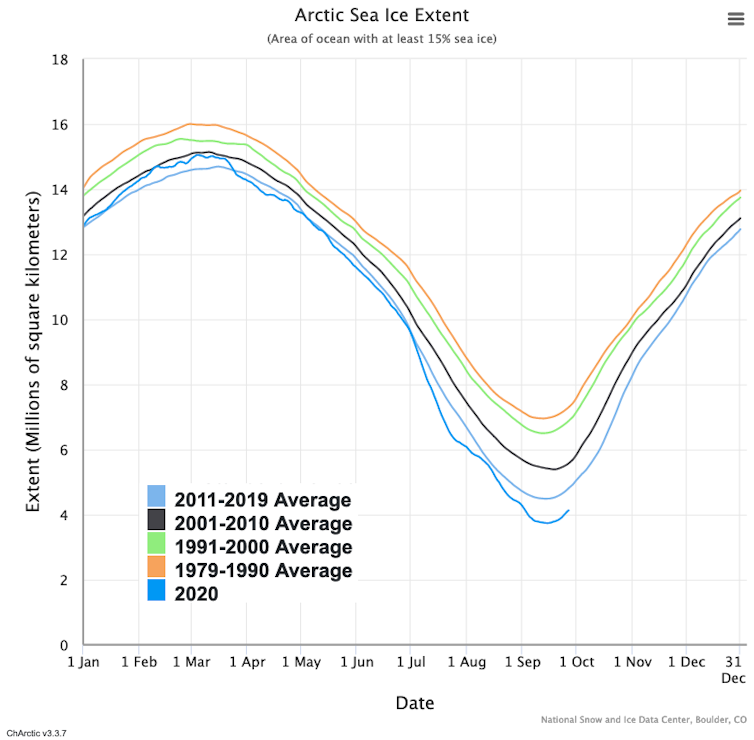
Every year, sea ice cover in the Arctic Ocean shrinks to a low point in mid-September.
The ice today covers only50% of the area it covered 40 years agoin late summer.
Each of the past four decades averages successively less summer sea ice.
Fossil pollen preserved in these cores shows that the Pliocene Arctic was very different from its current state.
In contrast, the Russian sediment cores containedpollen from trees such as larch, spruce, fir and hemlock.
Because the Arctic was much warmer in the Pliocene, the Greenland Ice Sheet did not exist.
Small glaciers along Greenlands mountainous eastern coast were among the few places with year-round ice in the Arctic.
Coastlines were far inland from their current locations.
The areas that are now Californias Central Valley, the Florida Peninsula and the Gulf Coast all were underwater.
Why was there so much CO2 in the Pliocene?
How did CO2 concentrations during the Pliocene reach levels similar to todays?
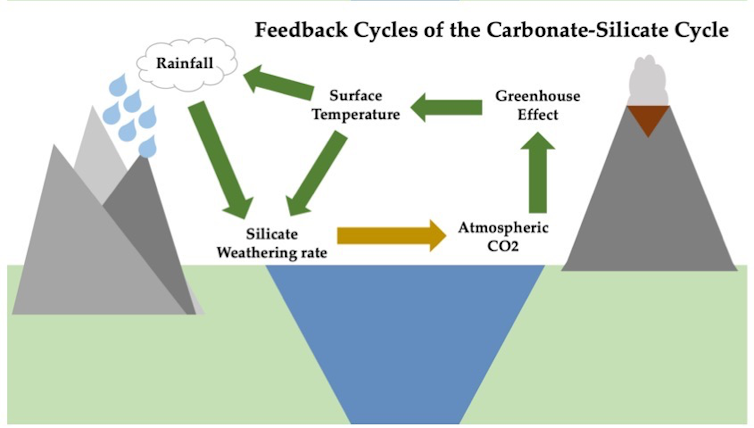
The Greenhouse Effect leads to increases in surface temperatures and, in some places, rainfall.

Together these accelerate silicate rock weathering.
Faster weathering in turn removes more CO2 from the atmosphere (yellow arrow).
The strength of the Greenhouse Effect relies on atmospheric CO2 levels.
Gretashum/Wikipedia
In soils, certain rocks continually break down into new materials in reactions that consume CO2.
But this thermostat has a built-in control.
When CO2 and temperatures increase and rock weathering accelerates, it pulls more CO2 from the atmosphere.
If CO2 begins to fall, temperatures cool and rock weathering slows globally, pulling out less CO2.
Rock weathering reactions also can work faster where soil contains lots of newly exposed mineral surfaces.
The rock weathering thermostat operates at a geologically slow pace.
It took over 50 million years to reduce them naturally to around 400 parts per million in the Pliocene.
Ecosystems had millions of years to adapt, adjust and slowly respond to changing climates.
A Pliocene-like future?
Today human activities are overwhelming the natural processes that pull CO2 out of the atmosphere.
At the dawn of the Industrial Era in 1750, atmospheric CO2 stood at about280 parts per million.
Most of that shift has happened since World War II.
Yearly increases of 2-3 parts per million now are common.
And in response, the Earth is warming at a fast pace.
As a result, summertime Arctic sea ice coverage is trending lower and lower.
Scientists project that the Arctic will becompletely ice-free in summerwithin the next two decades.
This isnt the only evidence of drastic Arctic warming.
Scientists have recordedextreme summer melt ratesacross the Greenland Ice Sheet.
