A colossal chess game of immense consequences is being fought in outer space, right now.
Those launches are but the sixth and seventh in a series intended to rapidly make1,584 satellites available.
The aim is to create a satellite connection called Starlink.
Why such outsized ambitions?
Musk would first target the3% or 4% of the US population living in remote areasoron island.
The financial benefits of providing Internet access to such a tiny slice of the nation are not obvious.
Thepolar regionsare not known for their density of wealthy but underserved American citizens, for example.
Could the expected profitability come from US defence spending?
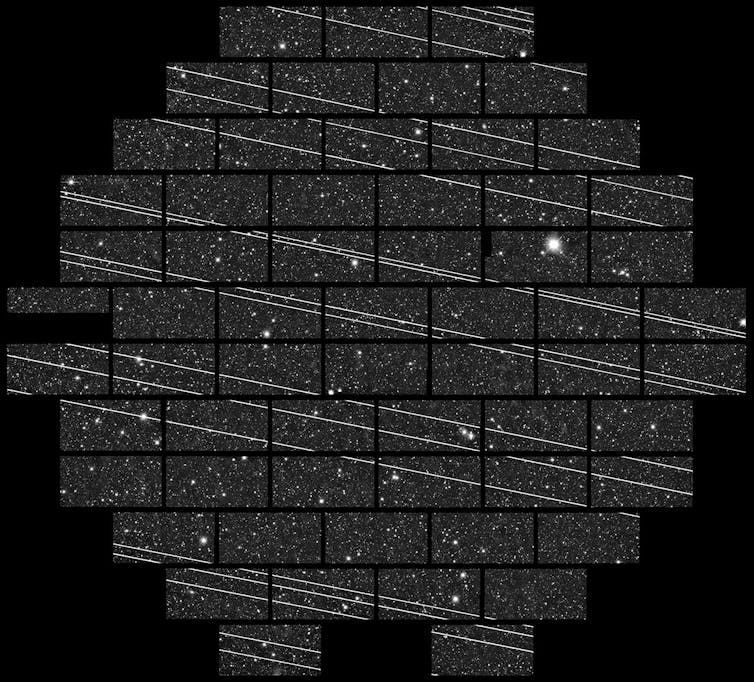
As they travelled across the skies, thousands of Starlink satellites would effectively makeastronomical images uselessby leaving longluminous trails.

This idea was tested with satellite 1130, DarkSat.
The results wereunconvincing,to say the least.
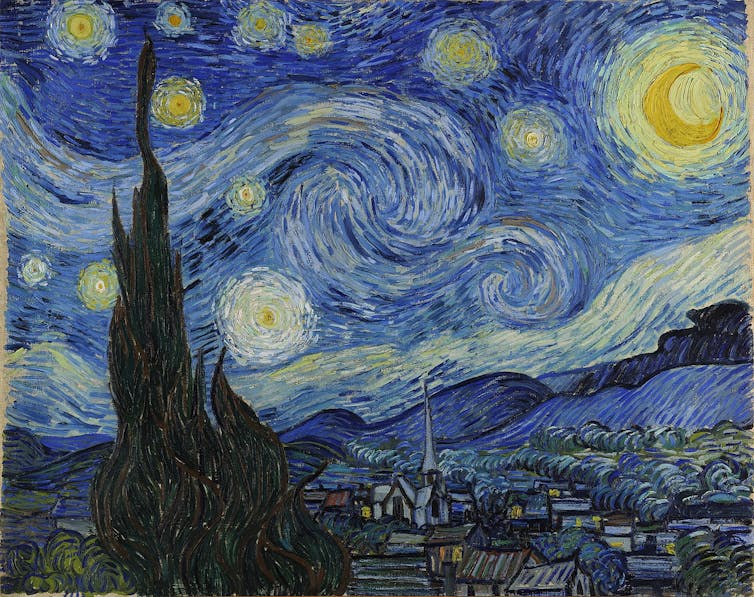
Starry Night, Vincent van Gogh, 1889.
It’s free, every week, in your inbox.
Other satellite operators are worried, too.
Below this altitude, residual atmospheric drag will eventually cause a failed satellite to fall out of orbit.
To follow and connect to them, buyers will have to use purpose-builtphased array antennas.
More troublingly, competitors are sharpening their knives.Kuiperis backed by Amazon,OneWebby billionaire Greg Wyler, andHongyanis Chinese.
Just as withelectrical scooters, investors are rushing into massive production, and the results could be disastrous.
Such unbridled competition has negative consequences from the environmental point of view as well as from the security andbusinessones.
The theory is that whoever is first past the post will gain near-monopoly power, cornering thepotentially colossal market.
We could well see several redundant satellite networks duke it out in the skies.
Yet, there will be only one winner.
Theirshare of world greenhouse gas emissions is already 4% and could double to 8% by 2025.
The Federal Communications Commission seems to be ready to give Musk its blessing.
The 1967Outer Space Treaty, declared outer space to be a common good of humankind.
Today this may seem quaint to some, but it is more necessary than ever.
