To succeed, product managers must demonstrate a specific set of core competencies no matter where they work.
But, the role of the product manager in a startup is particularly hard to define.
They operate with a wide range of responsibilities and huge pressure to deliver results, often without reporting authority.

How is the role of a product manager in a startup different from a large company?
The path of a startup is never predictable.
With less money and fewer people, product managers are flying the plane while building it.

From strategy and positioning to pricing and customer retention, they are challenged to do more with less.
What are the core competencies of a product manager?
It’s free, every week, in your inbox.
Even as raw talent,a handful of bedrock traits tend to define effective product managers.
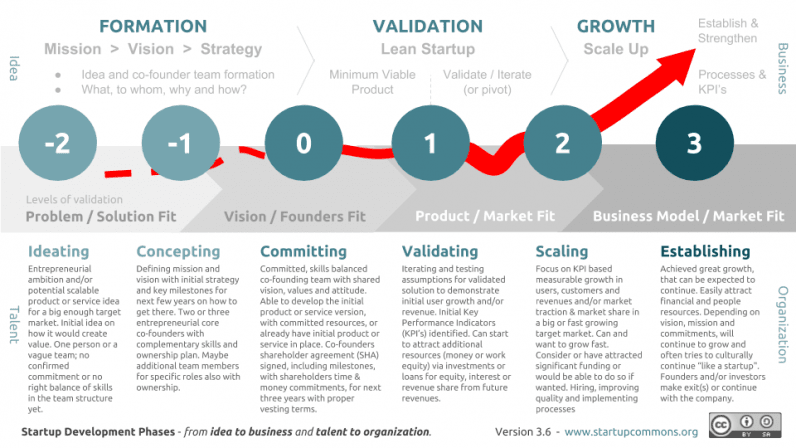
At each stage, they must develop the following lesser-known abilities to thrive.
The future is hazy and the team lacks structure.
During this time, they need to prove the concept and define a roadmap for the initial milestones.
The most fundamental question of Why this product?
is critical to answer.
If the problem space is well-defined and the market is well-known from previous experience, thats ideal.
Otherwise, thorough research and conversations with experts are essential.
The product manager helps definewhere to playandhow to win.
Synthesizing from the abstract
The product manager must then create a product to meet the stated goals.
This requires dissecting the broad vision, figuring out the knowns and unknowns, and launching a few prototypes.
The more disruptive the ideas, the more unknowns they need to explore.
This is a powerful phase that may shift the original purpose envisioned by the team.
Leapfrogging with partners
Time is a startups biggest enemy.
If they partner with other tools and technologies to build speedily, they can make it to market faster.
A product manager must discern whether to build or buy the necessary tech.
Often, going solo to develop the perfect product from the ground up is not a great choice.
Stage 2: VALIDATION
Here, the company has a minimum viable product to take to market.
Its built will they come?
If so, its time to move fast.
If not, the team needs to pivot and find a better direction.
Exuding self-belief
This phase repeatedly causes a product manager to question everything.
Execution will lack without it, and thats what makes or breaks a manifesting idea.
Its easy to end up throwing spaghetti against the wall to see what sticks instead of staying focused.
The product manager has to remain pragmatic.
They must carve out the core product and bench the other ideas for later.
Then, they have to control the guardrails and stop scope creep.
Showing empathy
Customer feedback is critical.
Its the ultimate report card of your decisions.
Nudging the user in the right direction is as important as knowing how they are responding.
Deep empathy and learning from customers will help counter personal bias, which the product manager must embrace.
Stage 3: GROWTH
Bigger, smarter, faster.
Thats the story of the growth phase.
Can their startup run with the big dogs, or is it time to hang up their hats?
Identifying and nurturing talent
Growth involves aggressive hiring.
Its a major transition and speed bumps are almost inevitable.
Fostering an engineering-design partnership
A successful product manager is backed by excellence in engineering and design.
A product manager defines whether the technology or the design (or both!)
can be product differentiators.
A hands-on approach with clear direction is vital to ensure developers dont over-engineer and designers dont get overly ambitious.
