It’s free, every week, in your inbox.
Past research has suggested such crowdsourced approaches to reducing misinformationmay be promisingin highlighting untrustworthy sources online.
That said, the usefulness of Twitters experiment will depend on the accuracy of users reports.
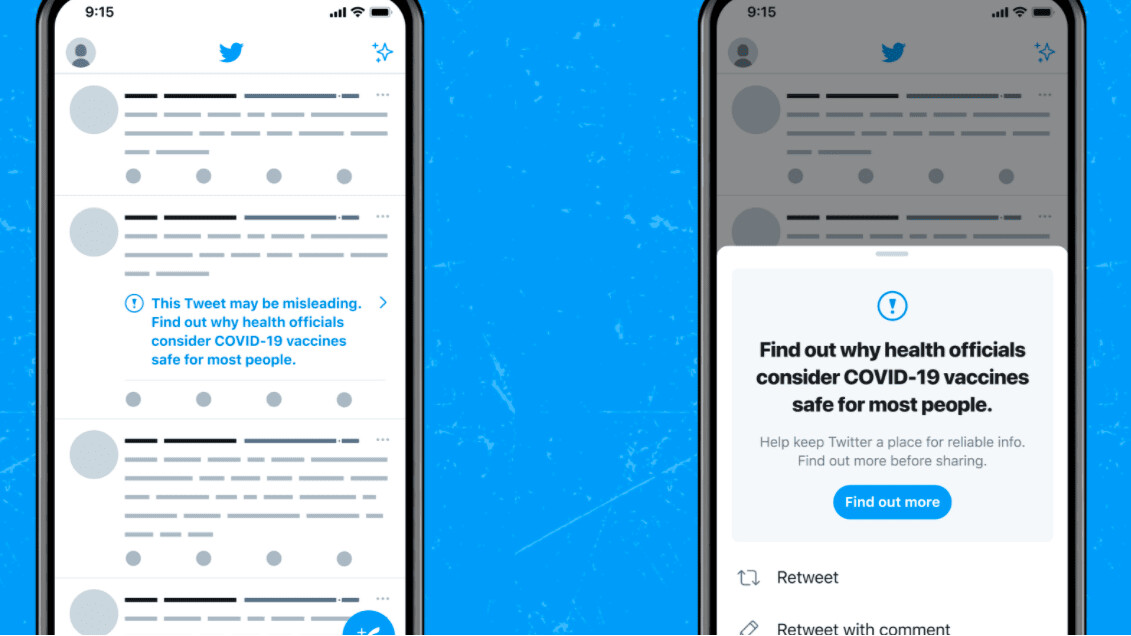
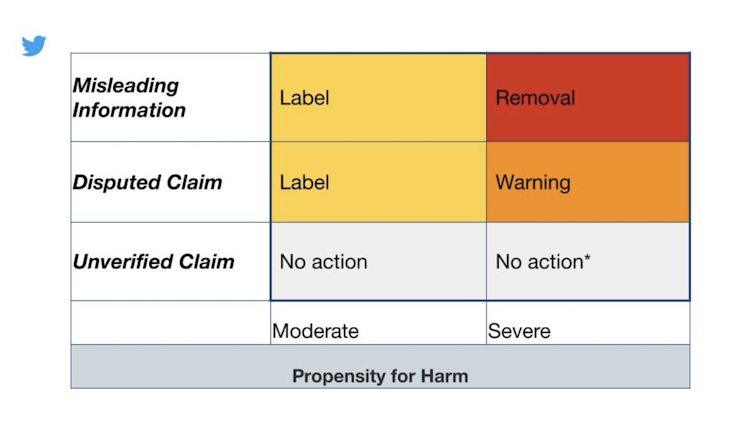
In a 2020 blog post, Twitter said it categorized false or misleading content into three broad categories.
But the platform has not explicitly defined misinformation for users who will engage in the trial.
So how will they know whether something is misinformation?

And what will stop users from flagging content they simply disagree with?
The more you hear certain information repeated, the more familiar it will feel.
In turn, this feeling of familiarity tends to be taken as a sign of truth.
Even deep thinkersarent immuneto this cognitive bias.
Even if an idea is misleading, if its familiar enoughit may still pass the test.
The social dilemma
Another challenge is a social one.
Group identityinfluences what information we think is factual.
Researchhas also shown we are inclined to look for evidence that supports our existing beliefs.
This raises questions about the efficacy of Twittersuser-led experiment.

Will users who participate really be capturing false information, or simply reporting content that goes against their beliefs?
Twitters misinformation experiment could be abused by well-resourced and motivatedidentity entrepreneurs.
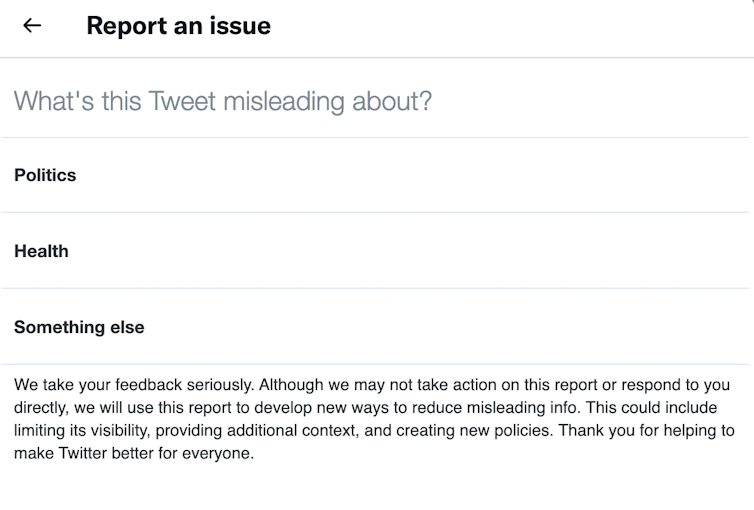
Twitter has added an option to report misleading content for users in the US, Australia and South Korea.
One way is to take a consumer-minded approach.
When we make purchases as consumers, we often compare products.
We should do this with information, too.
Searching laterally, or comparing different sources of information, helps usbetter discernwhat is true or false.
Similarly, there are many new andinteresting waysto learn about disinformation tactics intended to mislead us online.
In an online setting, this kind of mindset may leave people better placed to identify and flag misinformation.
So actively thinking about accuracy when engaging online is a good thing.
But what happens when I know someone else is onto it?
Even armchair activism may be reduced if there is a view misinformation is being solved.
Worse still, this belief may lead people to trust information more easily.
Such data, if made available in some capacity, have great potential to benefit the science of misinformation.
