To the average eye, extended reality is starting to look bleak.
Sadly for Mark Zuckerberg, consumers rarely want to strap computers to their faces.
But there is one place where business is booming: the military.
Under the deal, the tech giant would develop training programmes for HoloLens-based headsets.
Despite a shaky start literally, for thenauseated soldiers the partnership continues to this day.
But it might not last much longer: around80 firmsare now vying for the contract.

40% off TNW Conference!
And thats just on the ground.
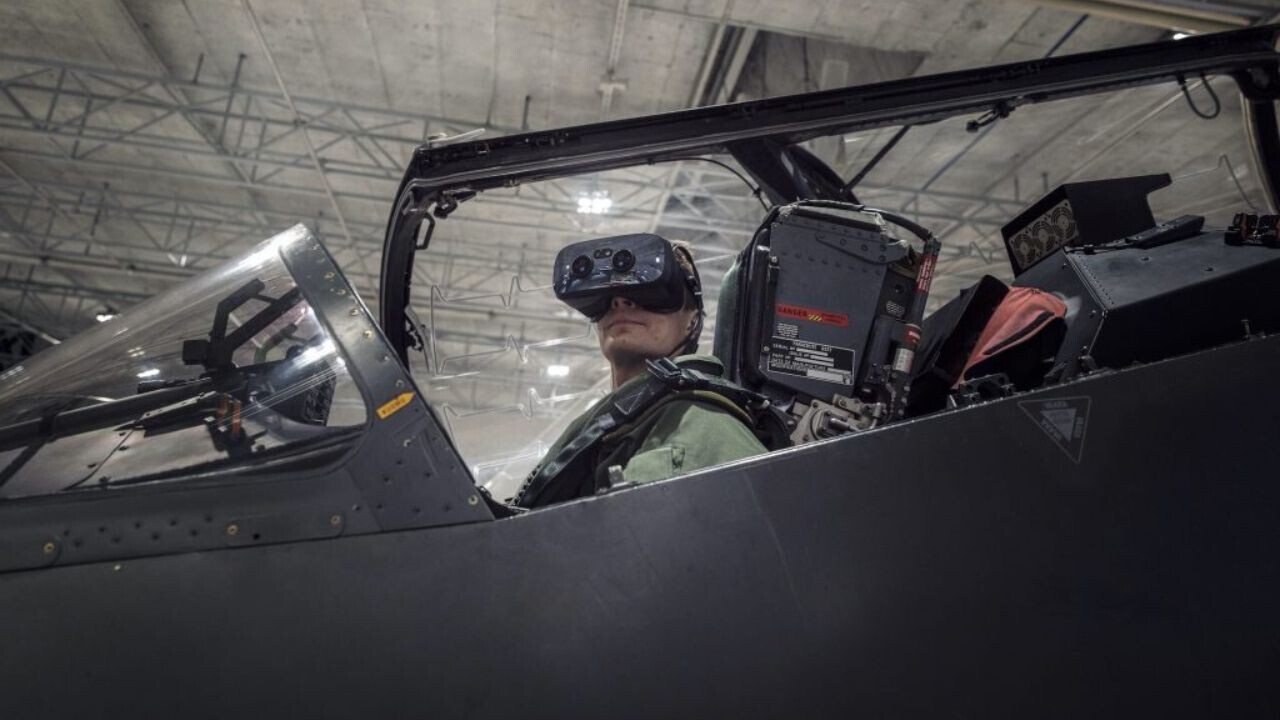
Arguably the fastest-growing military program for XR is pilot training.

In this segment, theres an undisputed European champion: Varjo.
The companys CEO, Timo Toikkanen, says a paradigm shift has begun.
The trigger was evolving needs for aircraft simulators.
Advances in XR paved a path towards compelling new systems.
One was recently delivered to Ukraine.
It will support the countrys latest aerial weapons: F-16 fighter jets.
Flight preparations
After years of lobbying western allies, Ukraine finally received its first F-16fighter jetsin August.
The shipment marked a milestone for the countrys air forces, which have hitherto relied on Soviet-era jets.
F-16s add a powerful upgrade to the fleet.
But theres a problem with the order: Ukraine doesnt have enough pilots who can fly the planes.
Traditional solutions to this problem come with their own issues.
Theyre also vast machines that require their own dedicated buildings.
XR can hurdle these barriers.
The simulators are cheaper than domes and can operate in offices.
They can also integrate systems from across the armed forces.
But their biggest strength today is their speed.
The training time of a fighter pilot is compressed by 30 to 50%, Toikkanen says.
When every year costs millions, thats a very significant change.
Ukraine has an urgent need for this fast and affordable training.
To train them, the country recently acquired its first fully-functional XR F-16 system.
Czech firm Dogfight Boss built the simulator, while Varjo supplied the XR tech.
After entering the cockpit, pilots learn the controls, fine-tune their techniques, and fly virtual missions.
Ukraines air forces can then reap the benefits.
But for Varjo, the country is a tiny addition to a ballooning global market.
The F-16 in Ukraine is one example of a much broader phenomena, Toikkanen said.
And the phenomena is traditional means of training pilots being replaced by mixed reality technology.
XR takes off
One of Varjos closest partners is Aechelon Technology.
The American company creates geo-specific visualisations of the real world, which have been integrated with Varjos XR system.
Together, the partners have crafted headsets for the US Air Force.
We are one of the big players in the US.
But Varjo istheplayer, Javier Castellar, the co-founder of Aechelon, tells TNW.
Castellar estimates that Varjo has captured at least 95% of the XR flight training market.
He calls the firm the Tesla of Finland.
This reputation in military aviation has blossomed rapidly.
A few years ago, XR wasnt technically capable of replacing air force simulators.
Fast forward to today, and Varjo is in over 80 military synthetic training programs across NATOs footprint.
Orders for XR, Castellar says, now outstrip those for domes by at least eight to one.
The reason for this turnaround is a big leap in tech.
Varjos breakthrough headset was the XR-4 series.
Releasedlast year, the devices blend a 360-degree view of the synthetic environment with the cockpit interior.
Castellar says the system crossed a threshold of human vision.
Inside the headset,foveated renderingtracks the pilots eyes and maximises the resolution where theyre looking.
By applying this technique, the XR-4 can boost visual quality while cutting computation needs.
Dual 4K x 4K displays can then deliver photorealistic scenes at 90 frames per second.
To integrate the pilots surroundings, two 40-megapixel cameras align the visual focus with the pilots gaze.
TNW got totest the techlast year and found the transition seamless.
As the uptake grows, new capabilities are emerging.
Its not just a display system, says Castellar.
It has major implications on defence.
Flying higher
Modern aircraft are expensive to update.
In domes, the costs are cut, but the changes still dont come cheap.
They can also involve laborious implementations.
XR promises a simpler solution.
The architecture can be continuously adapted, because it becomes more of a software problem, says Castellar.
The enhancements are potentially endless.
All these components can then enter mission rehearsals.
But thats only for aircraft.
Varjo expects XR to now spread across armed forces and into complex military operations.
The headsets will connect planes in the sky with ships at sea and vehicles on the ground.
Numerous simulators will join the same scenario.
Every element will connection into one environment.
You cant practise that in real life, Toikkanen says.
The only practice is to simulate.
The software also offers advanced data analytics.
you could measure a pilots cognitive stress, reaction speeds, or gaze direction.
Training programs can be tailored to their needs.
The insights could even shape real military equipment.
you’re free to make pilots fly aircraft that dont exist yet, Castellar says.
you might experience the effects of the performance on the battlefield and make design decisions based on that.
This affordable adaptability creates a recurrent business model.
In the future, Castellar envisions a service that resembles smartphone upgrade programmes.
Its normally a one-off purchase.
As evidence of the benefits increases, Castellar expects the uptake to snowball.
The defence market is typically slow-moving.
But when new tech gains traction, order numbers often proliferate.
They can also lead to new applications.
Endless military machines could eventually follow the XR flightpath.
These are no longer just training aids that are nice to have, Castellar says.
Theyre becoming absolutely fundamental for the defence posture of every country.
Story byThomas Macaulay
Thomas is the managing editor of TNW.
He leads our coverage of European tech and oversees our talented team of writers.
Away from work, he e(show all)Thomas is the managing editor of TNW.
He leads our coverage of European tech and oversees our talented team of writers.
Away from work, he enjoys playing chess (badly) and the guitar (even worse).
