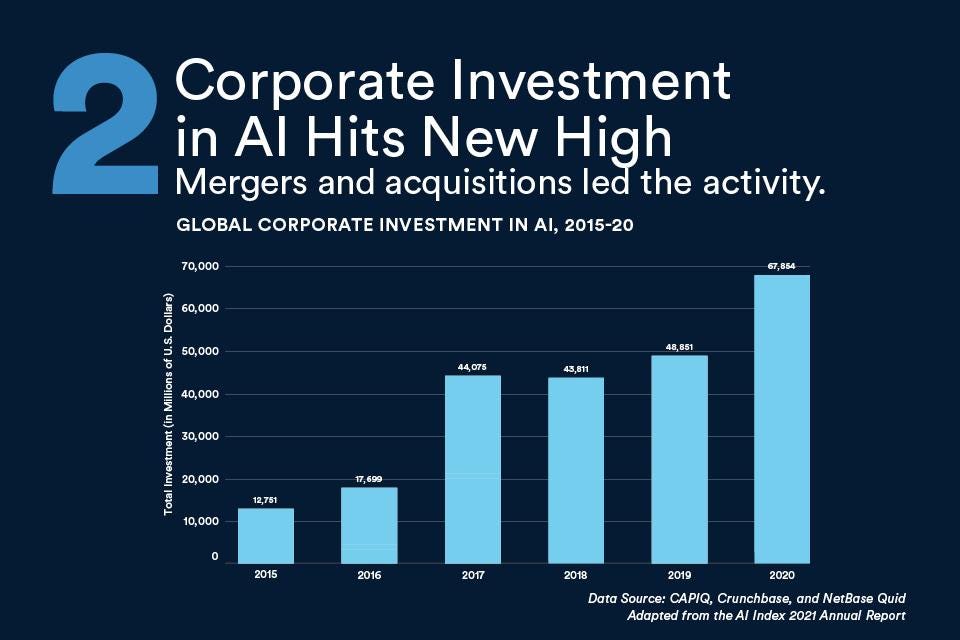
Last years AI investments topped even 2019s all-time high comfortably by 40%.
Given the steadily increasing investment in AI, Data Science comes under pressure to deliver tangible results.
The potential rewards ofintegrating AI into your business are immense.

Additionally, these AI High Performers spend more of their budget on AI initiatives than competitors.
They also have the capabilities to develop AI solutions in-house, instead of depending on external suppliers.
As Data Science matures, so does the pressure for the field to actually live up to the hype.
The field needs to deliver tangible business benefits.
[Read:How do you build a pet-friendly gadget?
First, lets analyze the roles of a traditional Product Owner and an AI Product Owner.

Product Owner vs. AI Product Owner
The role of the Product Owner is defined in theScrumframework.
Scrum is a popular agile development method.
The framework requires the roles of a Product Owner, Scrum Master, and Developer.
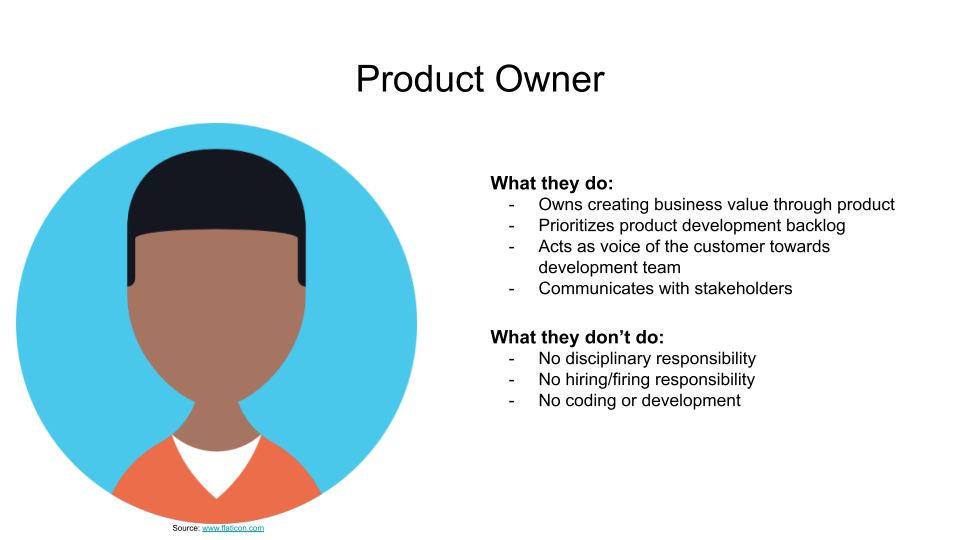
Scrum pays meticulous attention to divide the product and people responsibilities between the Scrum Master and Product Owner.
The Product Owner is responsible formaximizing the value of the Scrum team.
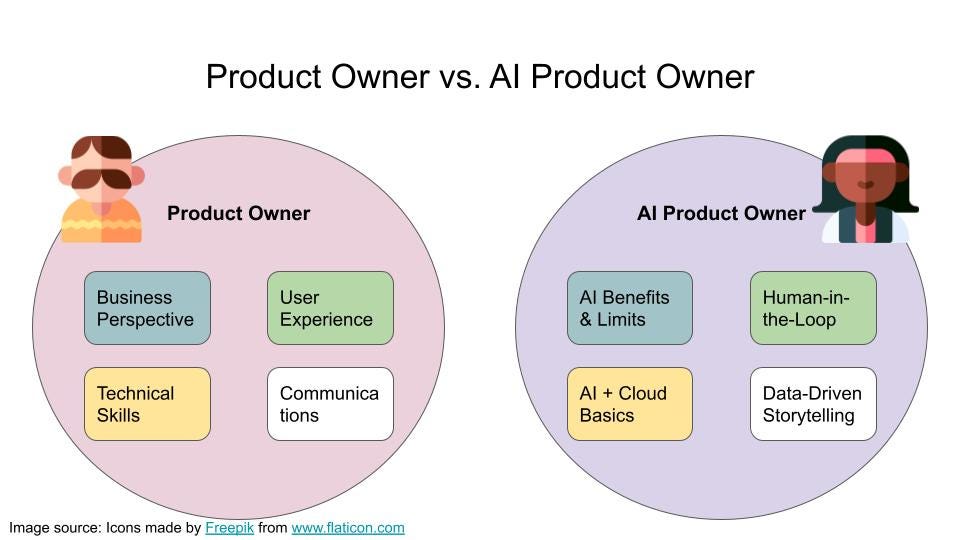
The AI PO role is an extended, specialized version of the general PO role.

AI POs inherit the responsibilities of a general PO.
They extend them to maximize the impact of AI-based Products.
AI-based Products differ from traditional software products.

First, AI uses data to learn patterns implicitly, instead of developers implementing rules explicitly.
Second, AI-based products have the chance to continuously improve with incoming data.
Hence, POs need to adjust their skills to deliver AI-based Products.
So, what skills do AI POs need?
First and foremost, AI POs need to know about the potentials and pitfalls of AI-based applications.
What is AI good at, where does it struggle?

Which business problems could an AI-based solution solve, where is it misplaced?
Next, AI POs need to pay special attention to monitoring the predictions of AI models.
AI is based on statistical assumptions, so the predictions always carry a degree of uncertainty.
Depending on the context, a wrong prediction can cause severe consequences.
AI POs should be able to design AI applications to include human decision-making when required.
They measure how customers react to their predictions.
AI Products also need to account for ongoing adjustments to data.
When designing AI-based Products, AI POs need to keep the virtuous cycle of AI in mind.
The true power of intelligent products comes from their ability to continuously improve based on new data.
On the technical side, the more technical knowledge AI POs have, the better.
AI POs neither need to be former developers nor have a Masters degree in Computer Science.
Yet, it is hard to understand what is easy and what is virtually impossible to implement with AI.
The feasibility of an AI Product can be hard to evaluate for AI POs without the proper technical background.
Last but not least, AI POs understand that AI development is different from the software development workflow.
AI development tests different hypotheses and iterates quickly.
Traditional software development can follow a more modular and structured approach.
Structuring data product teams
Delivering AI-based Products depends on forming cross-functional teams.
Cross-functional teams are staffed with experts with complementary skills and roles.
Too often, I have seen single-minded Data Science Teams struggling to operationalize their models.
Instead, the AI PO supports Data Scientists by maximizing business value.
The graphic above shows a prototypical AI Product development team with cross-functional experts.
Dont get hung up on the roles, they can change from one product to another.
Some products might need AI UI/UX designers, some might not.
However, I do believe that all AI Product teams should at least have an AI PO.
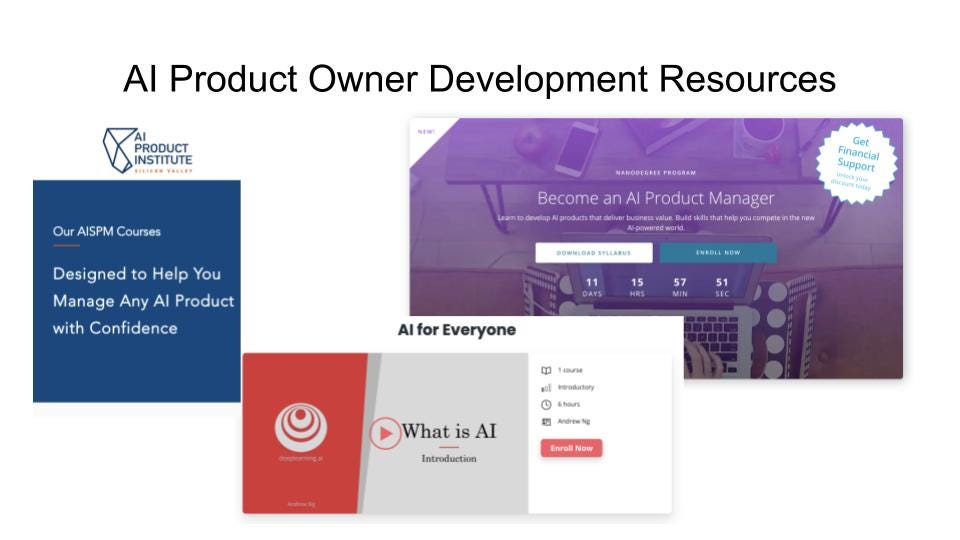
Adnan is doing great work in teaching at Stanford and working at Nvidia.
He also started the AI Product Management Institute to develop AI POs.
Adnan helps aspiring product owners break into the field of AI and has received thoroughly positive student feedback.
The Udacity nanodegree looks comprehensive and valuable.
I heard good feedback about the program.
For AI POs it is essential to understand the non-technical fundamentals of AI, which this course teaches you.
Instead of requiring Data Scientists to cover all product development stages, the AI PO supports AI Product teams.
The AI PO focuses on creating value through AI-based Products.
The AI Index 2021 Annual Report by Stanford University is licensed under Attribution-NoDerivatives 4.0 International.
To view a copy of this license, visithttp://creativecommons.org/licenses/by-nd/4.0/.
This article was originally published byJan ZawadzkionTowards Data Science.
you’re able to read the piecehere.
