An Israeli spacecraftcalled Beresheetalmost made it tothe moonin April.
Nowits been revealedthat the mission was carrying a cargo of dehydrated microscopic lifeforms known as tardigrades.
Beresheet was the first stage of a privately-funded initiative totransfer living DNA to the moon.

They are hardy creatures and could probably survive on the moon for a long time.
Is this a matter of concern?
I believe so, but possibly not for the reasons you might think.
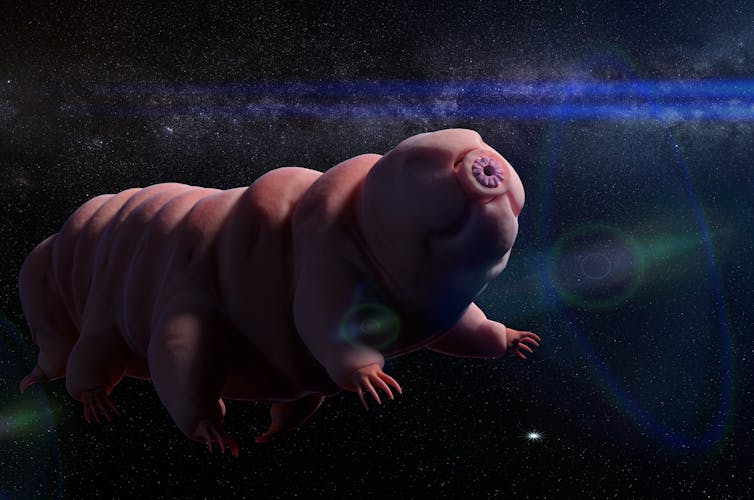
Tardigrades areodd little creatures.
Striking, or distinctive, are my adjectives of choice.
40% off TNW Conference!

The legs stick out at a slight angle, as if they are too swollen to stand upright.
Dotted Yeti/Shutterstock
Tardigrades can survive extremes of temperature and pressure, including the frigid vacuumof space.
They dont seem to mind beingexposed to radiationand are all-round tough little creatures.

But to live their life to the fullest requires water.
Interplanetary pollution
Im not concerned about polluting the moon with organisms that might reanimate.
My concern is about polluting the moon, full stop.
There is already a fairly sizableamount of debrisfrom redundant spacecraft and litter left behind by astronauts.
There is, though, another question to consider.
What if the spacecraft had crashed as it approached Mars rather than the moon?
Would the tardigrades have survived atmospheric entry?
If they had survived, would they ultimately be any more successfully on Mars than on the moon?
We know there is plenty of ice below the immediate surface across much of the planet.
Would an impacting spacecraft transfer sufficient energy to melt a local region of ice?
Could that meltwater survive without sublimating away or refreezing for long enough that the tardigrades rehydrate and wake up?
The surface of Mars should be kept pristine.
As detailed above, tardigrades need water to survive, not just to rehydrate them.
They live on fluids derived from other living beings.
And, as far as we know, there are noliving beings on Mars.
But we still keep sending spacecraft to look for life.
Sending a cargo of tardigrades to Mars would be irresponsible, even if we dont believe they would survive.
Irresponsible because Mars has the potential for life.
Restricted life, for sure, but we have no right to endanger that life.
And we have a responsibility to maintain Mars as close to pristine as possible, exploring it with care.
That is why space agencies take such stringent precautions about spacecraft construction.
The rooms in which the craft are built arecleaner and more sterilethan any operating theatre.
They take every precaution to ensure that no terrestrial life is transferred to Mars.
NASA and ESA are currently planning amission to returnsamples from Mars to Earth.
Last week, we had an asteroidpassing close to the Earth.
Next week, maybe it will be killer bees.
Or a plague of thieving magpies.
But for now it is water bears on the moon.
We should let them shrivel slowly into oblivion.
