The digital design industry is maturing.
We can aim for digital classics instead of one-hit wonders.
Industrial design is the poster child of longevity.
The timeless charm of aVespascooter.
The iconic contours of aCoca-Colabottle.
The elegant angles of anEameslounge chair.

Will there ever be a digital design equivalent to the ageless wonders of the industrial design world?
Can a user interface endure the decades like aLeicacamera?
Unlikely, it seems to be the answer.

Timeless design must be built on a timeless foundation, but digital is always shifting.
The shelf life of digital designs can be extended, however.
Even while the underlying technology continues to evolve.

It’s free, every week, in your inbox.
What if digital design could create the kind of culture-shaping marvels that industrial designers have long produced?
Aim for timeless design
It is no surprise that design systems are exploding in popularity.

A carefully crafted design system gives even the most rapidly evolving product a clear set of timeless principles.
Googles Material Design (2014)
The advent ofMaterial Designmarked a turning point in digital design.
For the first time, a major player like Google created a design language from scratch.

Material Designs components reference the subtleties of the physical world.
Inspired by paper, Material Design revolutionized the way we think about design for the digital world.
GOV.UK was one of the first government websites to focus on usability.

Bland, some might say, but the design team never aimed for aesthetics.
Instead, the focus wasinformation design: Give users the information they need to complete tasks in minimal time.
No frills, no fuss.

Such radical simplicity made GOV.UK an instant classic.
Takeaway: User interfaces dont have to be pretty to be successful.
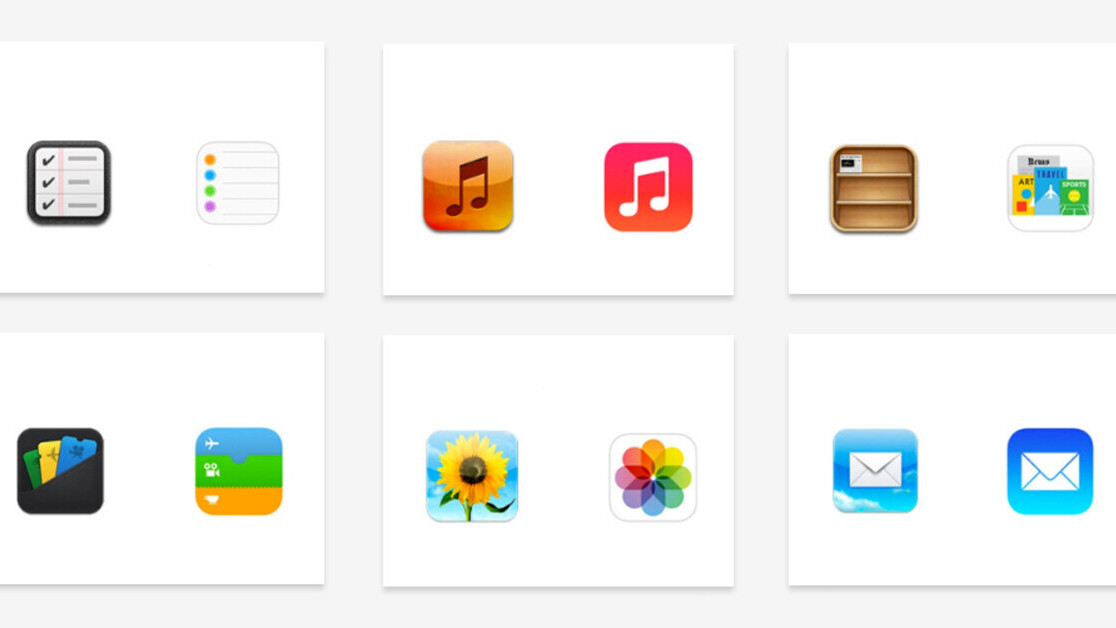
Farewell, wood grains.

Hello, stunning simplicity.
The skeuomorphism of iOS 6 versus the flat design of iOS 7.
To be fair, Android led the way with its implementation of flat design and arguably featured better animation.

Apple didnt totally abandon skeuomorphic effects in iOS 7.
However, the 2D interface is no longer forced to be something its not.
Takeaway: Flat design is king for 2D user interfaces.

While competing products sprang up promising all the features, Trello stood its ground and remained popularbecauseof its simplicity.
Trello bucked the feature-stuffing trend followed by so many of todays digital products.
Trello is a poster child of the80/20 rule in design(a.k.a.

The Pareto Principle).
Takeaway: Iterate carefully and apply the 80/20 rule.
Chrome stripped away all nonessential features in favor of high performance.
Googles major contribution here was makingperformancea must-have for all digital products going forward.
Chromes success is a testament to the importance of performance for great user experience.
Takeaway: Simplicity and performance alone can win in the long run.
Their dedication to sustainable, long-term products is reflected in the design of Basecamp 3.
Basecamp is an exception.
Takeaway: Sustainable businesses make for sustainable products.
Basecamps design longevity is rooted in the companys dedication to careful decision-making.
Takeaway: Great products can evolve, rather than reinvent, and still maintain their market lead position.
Googles homepage is remarkably similar to its earliest iterations.
Predictions of the future are usually skewed by the present, resulting in corny ideas that seemcomicalin hindsight.
After 50 years and counting, Stanley Kubricks UIs have stood the test of time.
The films concept interfaces featured something akin to a flat design aesthetic.
It took anotherfour decadesuntil Apple ditched skeuomorphism and followed suit.
Takeaway: Stanley Kubrick is a genius.
But if there were guiding principles, they ought to be universal, tech-adaptive, simple, and pragmatic.
This means designing for accessibility, performance, andinclusiveness.
As products become more widely adopted, multilingual experiences should be offered.
It does, however, mean that features are chosen deliberately and with the holistic experience in mind.
Apply the 80/20 rule and err on the side of simplicity when in doubt.
Pragmatic
Digital designs have much in common with plants in terms of longevity.
Like plants, they need to be constantly watered to survive.
If Google were to go bankrupt and close, its products would close with it.
Not true for physical products.
Industrial designers can be sure that their work will outlive them.
Not so for digital designers.
Furthermore, many startups are in survival mode.
They dont have the resources to explore how to add extra years of life to their interfaces.
More often than not, digital designers will see their work perish before they see it age.
In such circumstances, longevity isnt the first, second, or even fifth priority of digital product design.
Products must make it through their first few years of existence before they can worry about aging well.
